
I. 1st state of 7, 1994
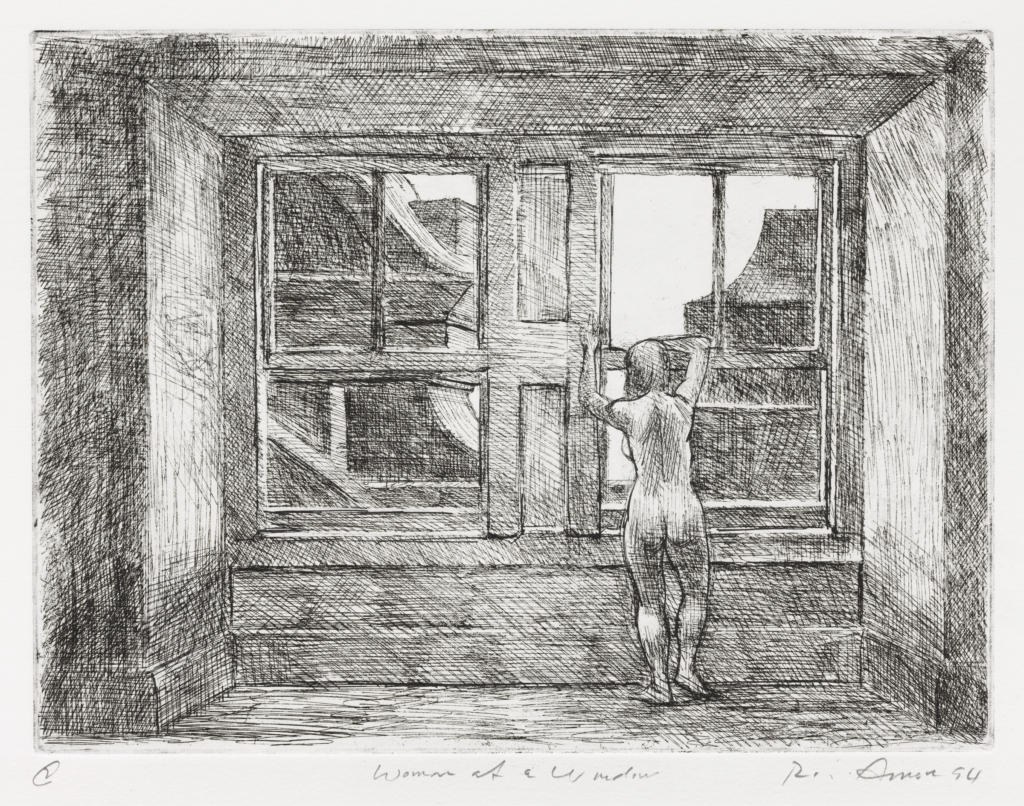
II. 2nd state of 7, 1994, extensively touched with pen and ink
II. 2nd state of 7, 1994, extensively touched with pen and ink
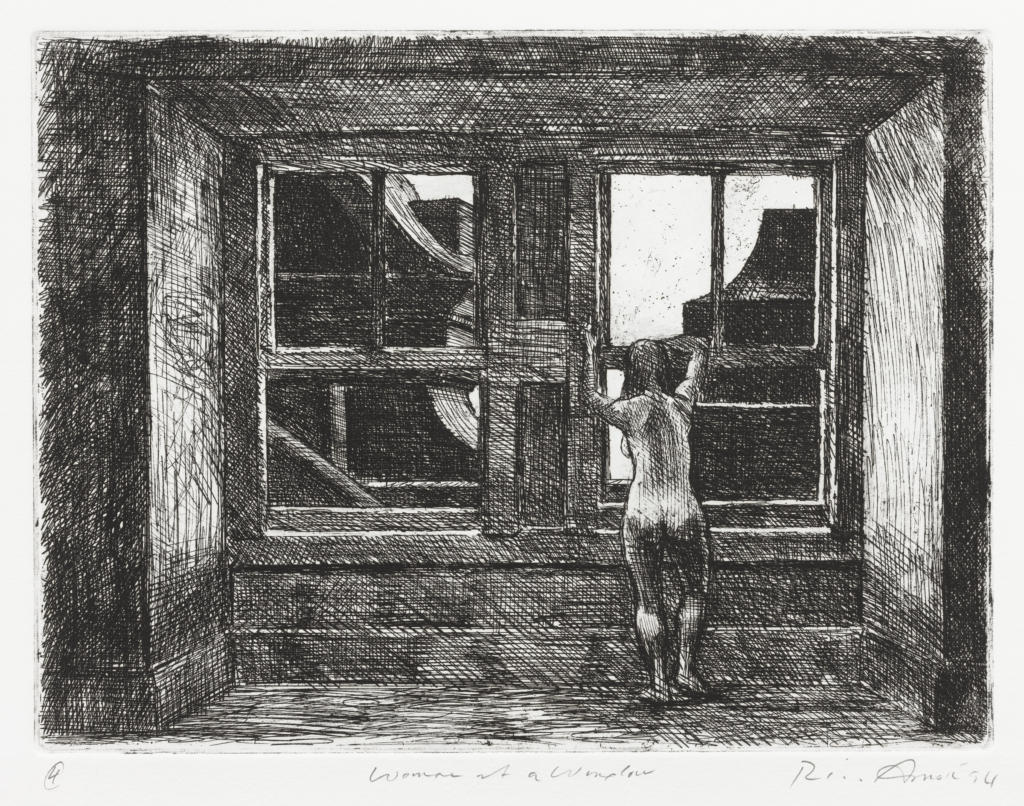
IV.a. 4th state of 7, 1994
IV.a. 4th state of 7, 1994
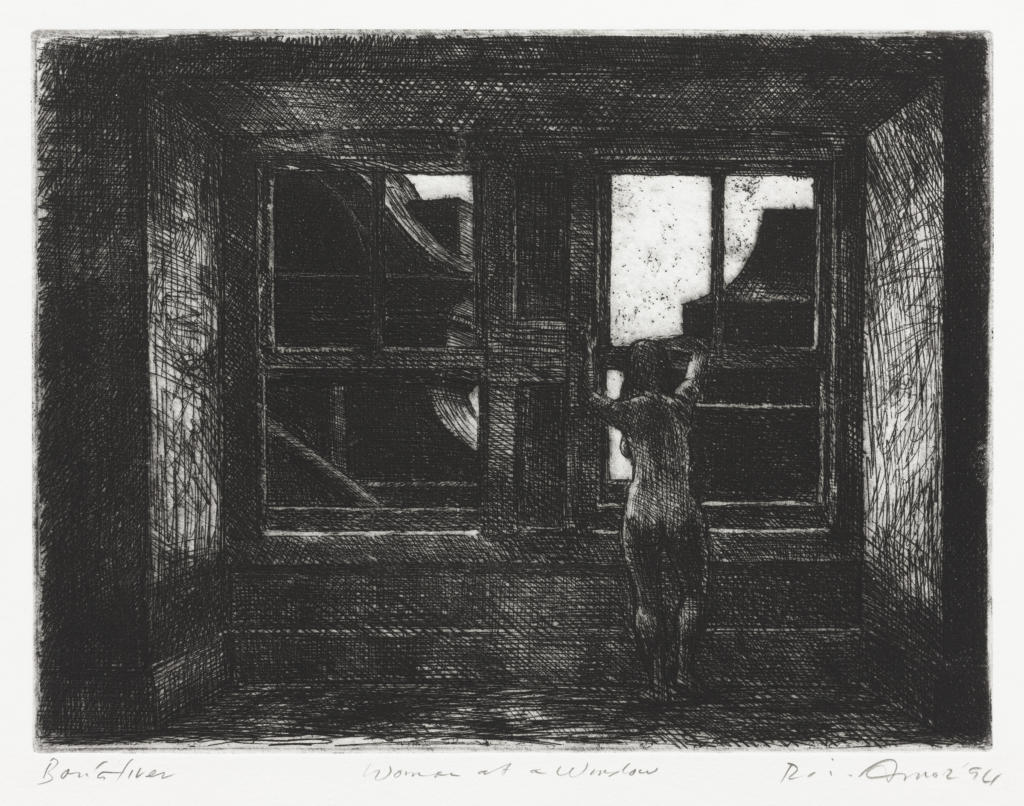
VI. 6th state of 7, 1994 (Featured Image)
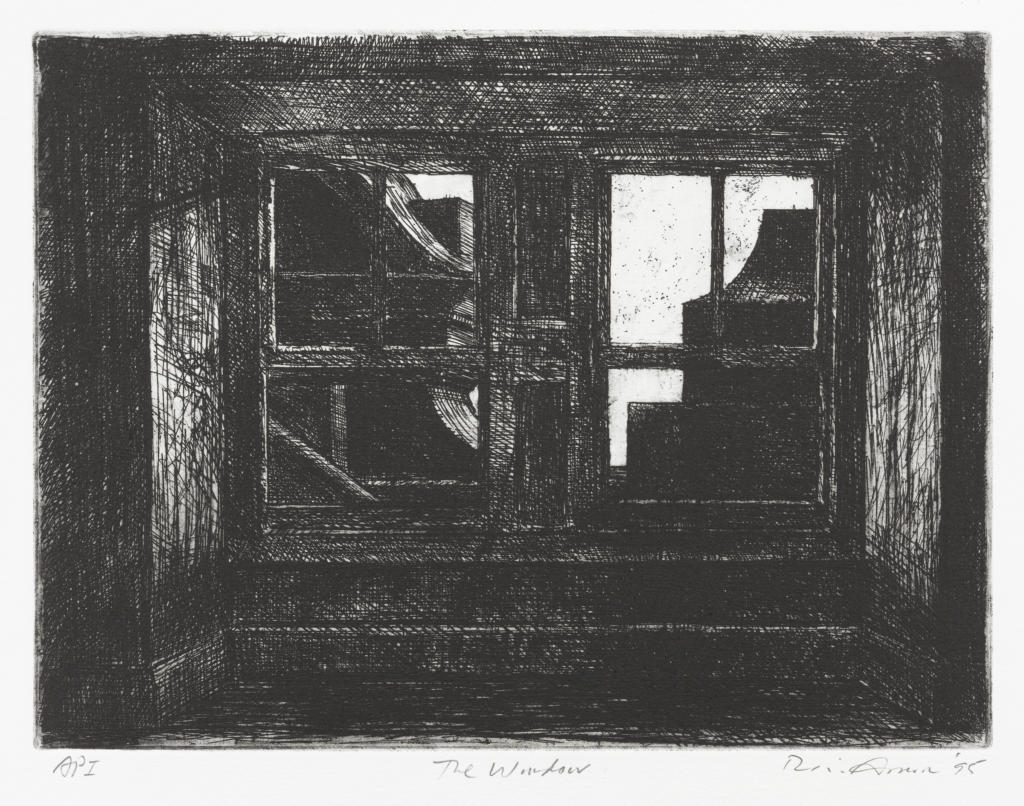
VII.b. 7th and final state, 1995, as The window
VII.b. 7th and final state, 1995, as The window
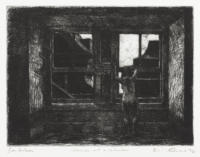
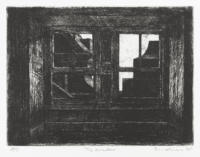
E.088 Woman at a window 1994; reworked and retitled 1995
I. 1st state of 7, 1994
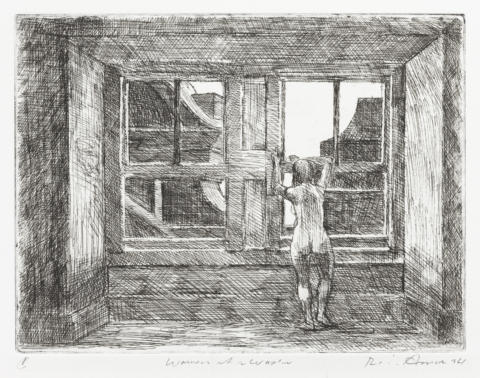
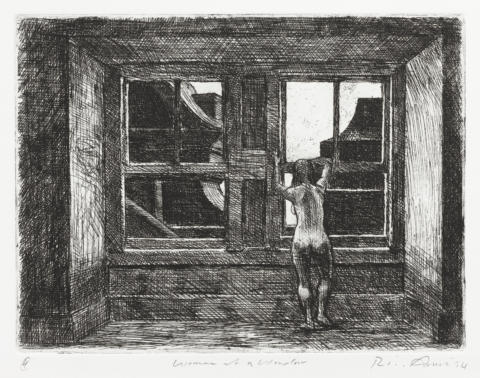
Etching. A naked woman, viewed from behind, stands in an alcove, looking out of a window. She leans with her right forearm on the sash window as she looks upon city buildings. The subject is lightly etched.
Impression on wove BFK Rives paper with watermark, printed by Rick Amor in his Alphington studio. Inscribed in pencil, below the plate mark: lower left: ‘1 [circled]’; lower centre: ‘Woman at a Window’; lower right: signed and dated: ‘Rick Amor 94’.
II. 2nd state of 7, 1994, extensively touched with pen and ink
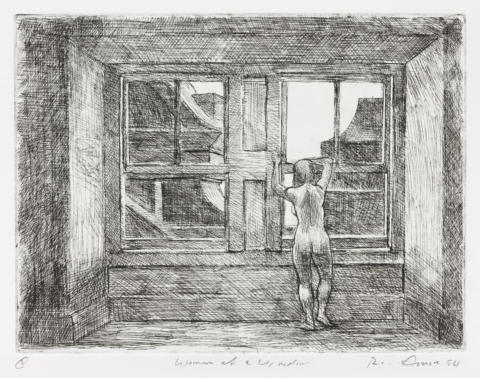
The woman’s right hand has been burnished away, so as to minimize disruption to the window’s geometry. The impression has been drawn over, with pen and indian ink, around the contour of the woman’s body, including her legs, as well as on her back and hair. Architectural details have also been strengthened with pen and ink.
IV.a. 4th state of 7, 1994
The changes indicated at the second state have been carried, and the plate has been re-etched. The space between the two windows has been darkened, as have the buildings beyond the windows; they now stand out more clearly. The woman’s upper buttocks have been burnished. There are two variant impressions of this state.
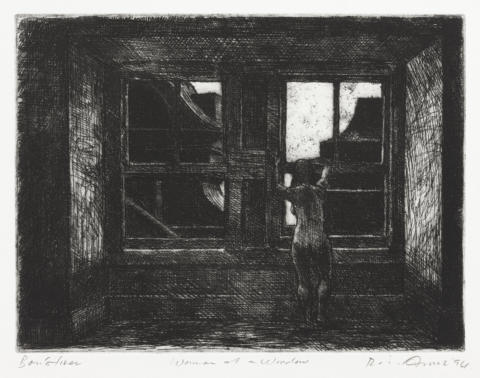
VI. 6th state of 7, 1994 (Featured Image)
Much new etching has been added to the woman’s body, to the floor and to the wall at right.
Dark, heavily inked impression with plate tone, on wove BFK Rives paper with watermark, printed by Rick Amor in his Alphington studio. Inscribed in pencil, below the plate mark: lower left: ‘Bon à tirer’; lower centre: ‘Woman at a Window’; lower right: signed and dated ‘Rick Amor ’94’. Although inscribed ‘Bon à tirer’, this is the sixth state.
VII.b. 7th and final state, 1995, as The window
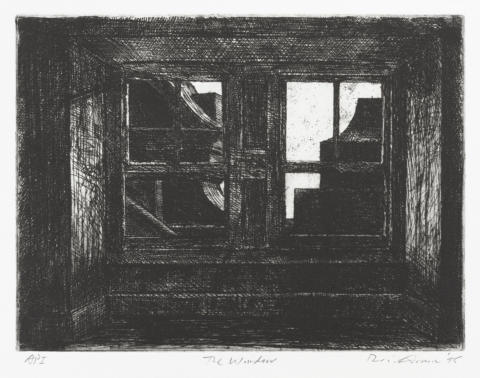
The work has been retitled The window. The plate has been reworked with burnishing and drypoint. The figure of the woman has been burnished out and in her place a square-edged building has been etched as part of the view through the window. An oblique shadow has been added to the upper left corner of the left window. More loosely etched vertical lines appear on the walls on either side of the window. There are four variant impressions of this state.
Etching. A naked woman, viewed from behind, stands in an alcove, looking out of a window. She leans with her right forearm on the sash window as she looks upon city buildings. The subject is lightly etched.
The woman’s right hand has been burnished away, so as to minimize disruption to the window’s geometry. The impression has been drawn over, with pen and indian ink, around the contour of the woman’s body, including her legs, as well as on her back and hair. Architectural details have also been strengthened with pen and ink.
The changes indicated at the second state have been carried, and the plate has been re-etched. The space between the two windows has been darkened, as have the buildings beyond the windows; they now stand out more clearly. The woman’s upper buttocks have been burnished. There are two variant impressions of this state.
Much new etching has been added to the woman’s body, to the floor and to the wall at right.
The work has been retitled The window. The plate has been reworked with burnishing and drypoint. The figure of the woman has been burnished out and in her place a square-edged building has been etched as part of the view through the window. An oblique shadow has been added to the upper left corner of the left window. More loosely etched vertical lines appear on the walls on either side of the window. There are four variant impressions of this state.
- Catalogue Number
- E.088
- Title and Date
- Woman at a window
1994; reworked and retitled 1995
- Subsequent Title(s)
- The window
- Description of Featured Image
- A naked woman, viewed from behind, stands in an alcove, looking out of a window. She leans with her right forearm on the sash window as she looks upon city buildings. Although inscribed as a bon à tirer impression, this is actually the sixth state of this print. In 1995, the print was reworked in a seventh and final state, as The window (see cat. no. E.088.1).
- Where Made
- Alphington, Melbourne
- Medium Category and Technique
- Intaglio Print: Etching, burnishing and drypoint on copper
- Support
- Wove paper. Identified papers: BFK Rives paper with watermark: ‘BFK RIVES / FRANCE’ with infinity symbol.
- Dimensions
-
Image size: 225 x 300 mm
Matrix size: 226 x 300 mm - Artist’s Record Number
- RAE.85 (1994), RAE.94 (1995)
- Printer(s) and Workshop(s)
- All impressions printed by Rick Amor in his Alphington studio.
- Summary Edition Information
- Seven states. No edition.
- Literature
- For an illustration of the painting The window, 1994–95, see Robert Lindsay, Rick Amor: Standing in the Shadows (exh. cat.), McClelland Gallery and Sculpture Park, Langwarrin, Victoria, 2005, cat. no. 54, p. 66.
- For an illustration of the painting Across the city, 1995, see Gavin Fry, Rick Amor, Beagle Press, Roseville, NSW, 2008, p. 60.
- Collections
- State Library of Victoria, Melbourne: seven state impressions, numbered 1, 1A through 6, all dated 1994 (Woman at a window); bon à tirer impression, dated 1994 (Woman at a window); AP II, dated 1995 (The window).
- Comment
This composition brings together the subjects of two separate drawings: a life drawing of a female nude, and a depiction of an interior at Spencer Street Station, Melbourne, before it was renovated and renamed Southern Cross Station (2005).
There are two principal versions of this etching. The initial version, from 1994, includes a rear view of a full-length female nude, who is depicted looking out of the window; the reworked and retitled version, from April 1995, shows an empty room, the figure having been burnished out. Amor’s tendency towards favouring the geometry of the composition over the figure in this print is clear as early as the second state; here, the woman’s right hand was removed from the window, by means of burnishing, so as not to disturb the window pane’s sharp angle in the lower left corner. The seven states of the etching proceeded from a light tonality towards a moody darkness, which, in the 1995 version, finally excluded the human presence.
In working through to the final state, Amor recalled a comment made by his teacher John Brack (1920–1999) about one of Amor’s early paintings, which showed a nude in a landscape. ‘You can’t put a naked lady in a paddock,’ Brack had said. Amor had understood this to mean that he should think carefully about the appropriateness of the settings in which he placed his figures. In 1995, having remembered his teacher’s remark, he removed the nude from this print.
The composition of the final state of the etching was used by the artist in an oil painting of 1994–95, The window (Lindsay 2005), and the fragment of nineteenth-century architecture seen through the left window in E.088 appears in the painting Across the city, 1995 (State Library of Victoria) (Fry 2008).
- Keywords
- Building interior, Nude, Spencer Street Station, Melbourne
- URL
- https://catalogue.rickamor.com.au/works/intaglio/woman-at-a-window/
Record last updated 15/02/2021