Rick Amor

An Online Catalogue Raisonné of the Prints by Irena Zdanowicz

  • About
  • Self portrait
  • Home
  • Home
  • Chronology
  • Interior
  • About
  • Acknowledgements
  • Contact
  • Catalogue
  • Guide to Entries
  • Man
  • Selected Bibliography
  • Guide to Entries
  • Selected Exhibitions
  • Contact
  • Collections
  • Printers & Workshops
  • The Project Team or Who Did What
  • Acknowledgements
  • Links
  • Home
  • Catalogue
  • The rock and the sea (large plate)

The rock and the sea (large plate) 1990

Previous
Next

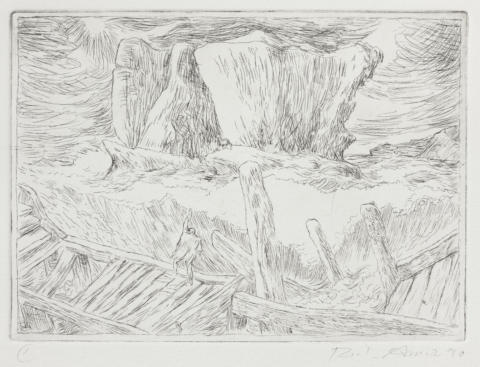
I. 1st state of 10

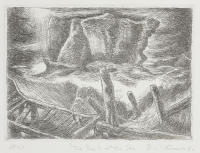
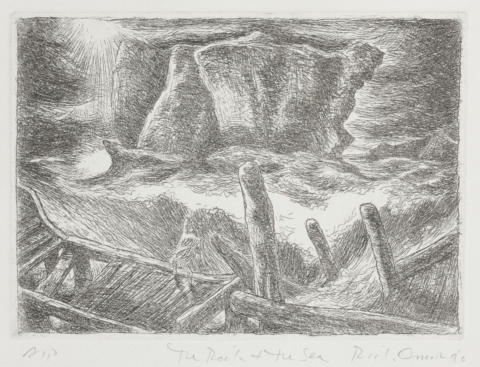
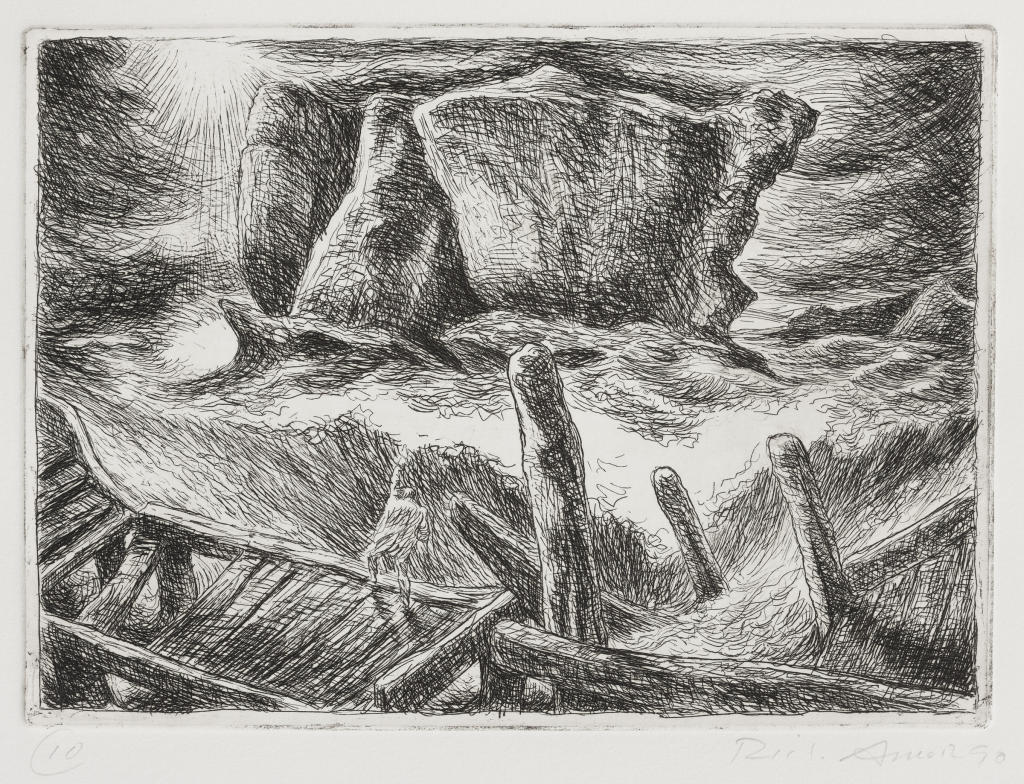
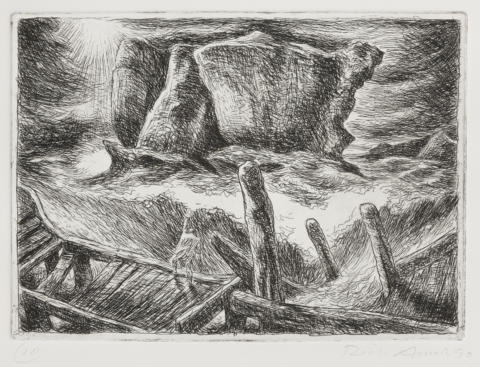
X.a. 10th and final state (Featured Image)
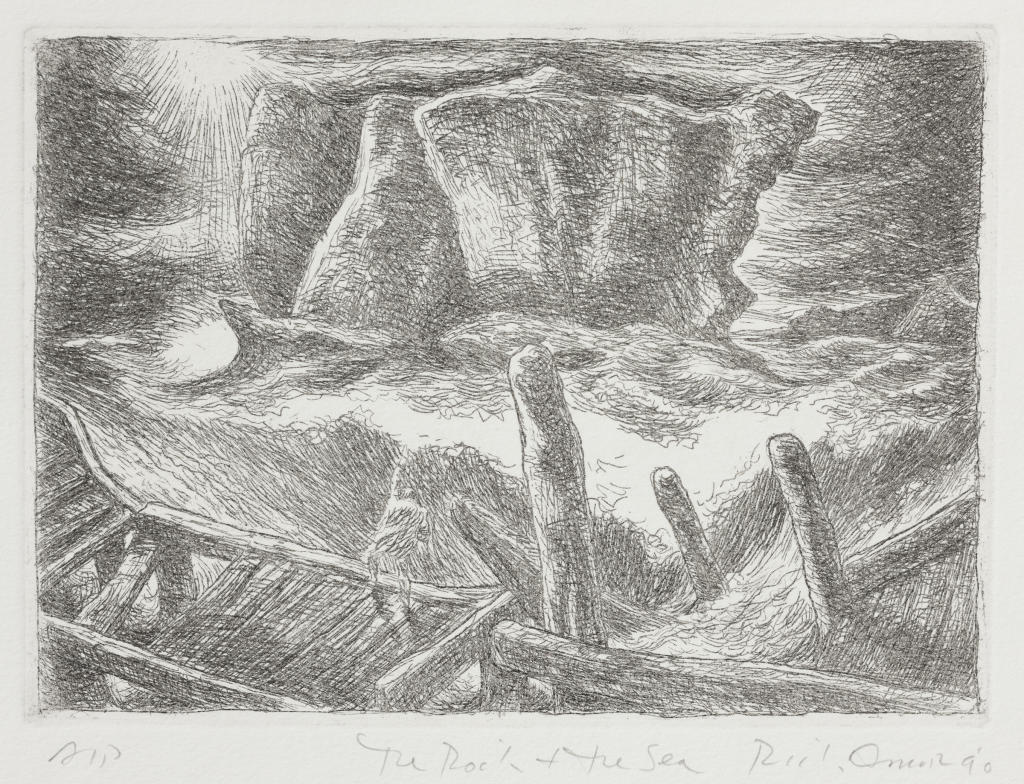
X.d. Maculature of 10th and final state
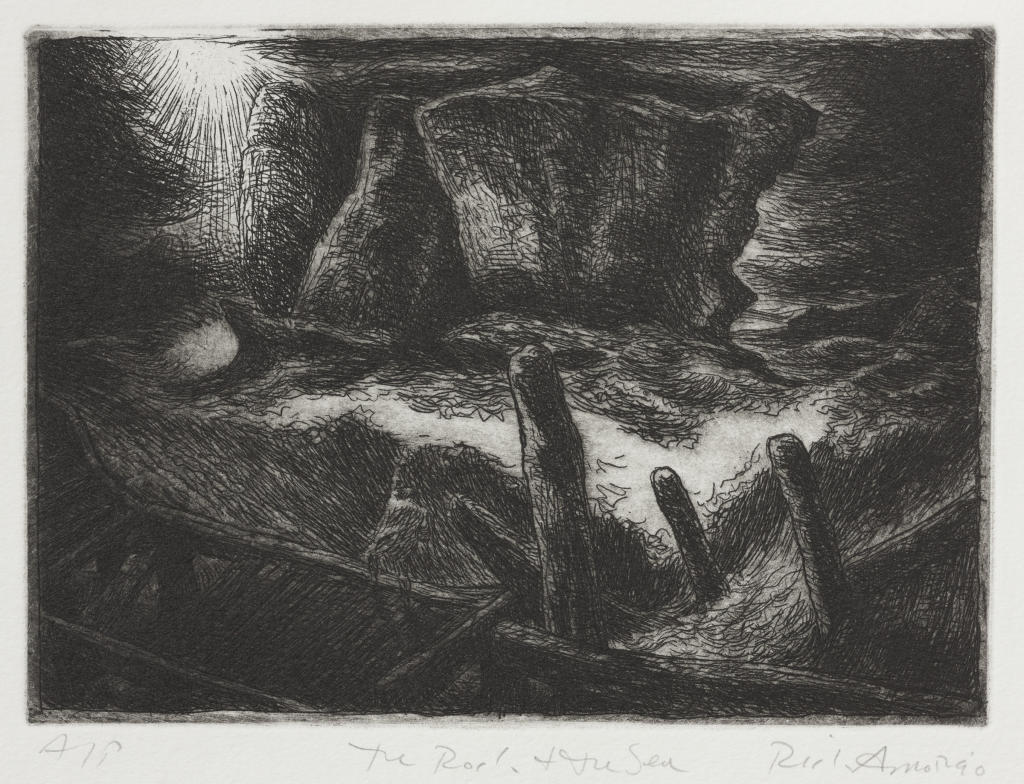
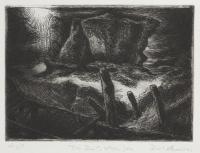
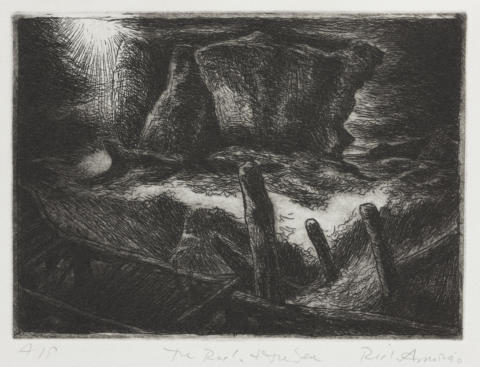
X.e. Dark, selectively wiped artist’s proof of 10th and final state
Close the overlay

E.028 The rock and the sea (large plate) 1990

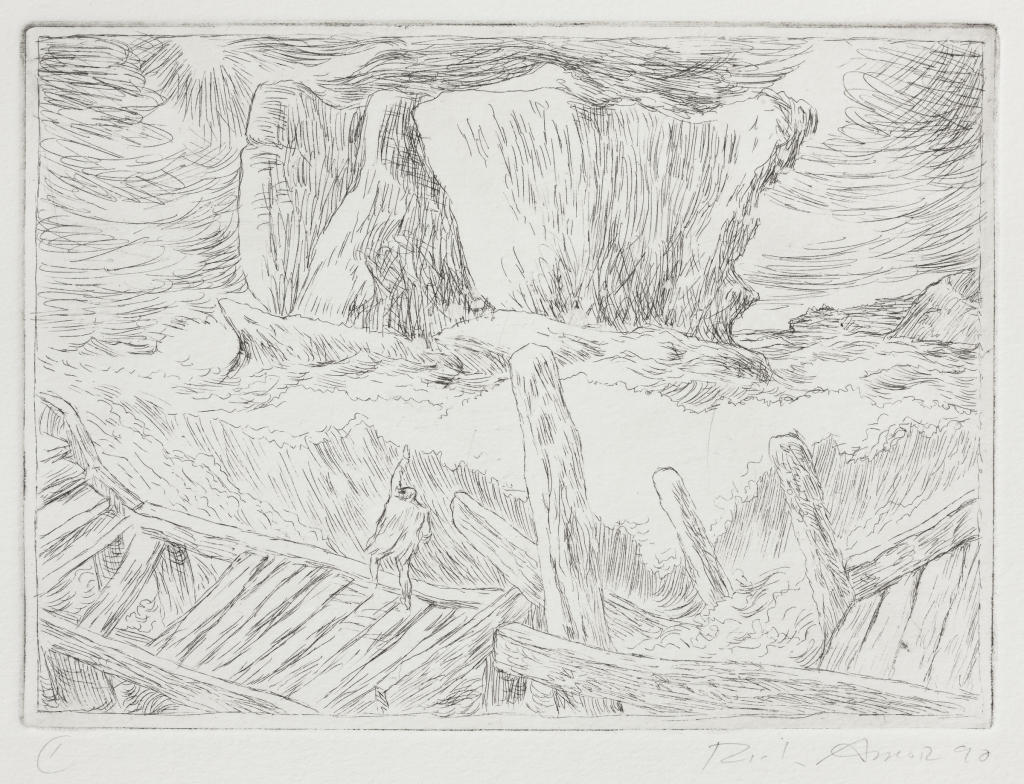
  • I. 1st state of 10

    Etching. On a crumbling pier amid stormy seas stands a lone figure looking towards a monolith on the horizon, and gesturing, with his left arm raised. The subject is lightly etched but substantially complete.

    Impression on wove paper, printed by Rick Amor in his Dunmoochin studio. Inscribed in pencil, below the plate mark: lower left: ‘1 [circled]’; lower right: signed and dated ‘Rick Amor 90’.

  • II. 2nd state of 10

    Etched hatching has been added to many areas – the sky, the rock, the sea, the pier and the figure’s raised left arm – defining the image more strongly and giving it a greater sense of plasticity.

    Impression on wove paper, printed by Rick Amor in his Dunmoochin studio. Inscribed in pencil, below the plate mark: lower left: ‘2 [circled]’; lower right: signed and dated ‘Rick Amor 90’.

  • III. 3rd state of 10

    More etched modelling has been added throughout, and the rays of the sun, at the upper left, have been extended. Some foul biting is evident in the water to the left of the figure.

    Impression on wove paper, printed by Rick Amor in his Dunmoochin studio. Inscribed in pencil, below the plate mark: lower left: ‘3 [circled]’; lower right: signed and dated ‘Rick Amor 90’.

  • IV. 4th state of 10

    Etching has been used to better define the lowest member of the broken pier, at the lower right.

    Impression on wove paper, printed by Rick Amor in his Dunmoochin studio. Inscribed in pencil, below the plate mark: lower left: ‘4 [circled]’; lower right: signed and dated ‘Rick Amor 90’.

  • V. 5th state of 10

    The rays of the sun have been extended further, and more etching has been added to the sky. Etched detail has been added to the modelling of the rock, to the section of pier at the lower right, and to the waves. Cross-hatching has been added to the steps on the pier, whose wooden beams have also been darkened.

    Impression on wove paper, printed by Rick Amor in his Dunmoochin studio. Inscribed in pencil, below the plate mark: lower left: ‘5 [circled]’; lower right: signed and dated ‘Rick Amor 90’.

  • VI. 6th state of 10

    Loose etching has been added to the sky at the upper left, so that it is now darker; however, the sun’s rays have been burnished at their centre, making that area lighter. The contours of the posts at the lower right have been strengthened with etching, as has the edge of the wave at the centre right. The right portion of the rock has been modelled with additional etched hatching.

    Impression on wove paper, printed by Rick Amor in his Dunmoochin studio. Inscribed in pencil, below the plate mark: lower left: ‘6 [circled]’; lower right: signed and dated ‘Rick Amor 90’.

  • VII. 7th state of 10

    The right part of the rock has been hatched with a loose horizontal zigzag, and the illuminated top of the rock has been more clearly defined with etching.

    Impression on wove Fabriano paper with watermark, printed by Rick Amor in his Dunmoochin studio. Inscribed in pencil, below the plate mark: lower left: ‘7 [circled]’; lower right: signed and dated ‘Rick Amor 90’.

  • VIII. 8th state of 10

    The lowest parts of the sun’s rays have been burnished so as to extend the illumination downwards.

    Impression on wove Fabriano paper with watermark, printed by Rick Amor in his Dunmoochin studio. Inscribed in pencil, below the plate mark: lower left: ‘8 [circled]’; lower right: signed and dated ‘Rick Amor 90’.

  • IX. 9th state of 10

    The upper left of the rock has been lightly burnished, in order to highlight it more.

    Impression on wove paper, printed by Rick Amor in his Dunmoochin studio. Inscribed in pencil, below the plate mark: lower left: ‘9 [circled]’; lower right: signed and dated ‘Rick Amor 90’.

  • X. 10th and final state

    The lower left area of the right segment of rock has been burnished so that the sense of physical bulk is emphasized. There are five variant impressions of this state, including a maculature.

    1. Impression on wove Fabriano paper with watermark, printed by Rick Amor in his Dunmoochin studio. Inscribed in pencil, below the plate mark: lower left: ‘10 [circled]’; lower right: signed and dated ‘Rick Amor 90’. (Featured Image)
    2. Impression on wove Fabriano paper with watermark, printed by Rick Amor in his Dunmoochin studio. Inscribed in pencil, below the plate mark: lower left: ‘11 [circled]’; lower right: signed and dated ‘Rick Amor 90’. Although inscribed ‘11’, this is an impression of the tenth and final state.
    3. Impression on wove paper, printed by Rick Amor in his Dunmoochin studio. Inscribed in pencil, below the plate mark: lower left: ‘12 [circled]’; lower right: signed and dated ‘Rick Amor 90’. Although inscribed ‘12’, this is an impression of the tenth and final state.
    4. Maculature on wove paper, printed by Rick Amor in his Dunmoochin studio. Inscribed in pencil, below the plate mark: lower left: ‘A/P’; lower centre: ‘The Rock & the Sea’; lower right: signed and dated ‘Rick Amor ’90’.
    5. Dark, selectively wiped impression with much plate tone, on wove paper, printed by Rick Amor in his Dunmoochin studio. Inscribed in pencil, below the plate mark: lower left: ‘A/P’; lower centre: ‘The Rock & the Sea’; lower right: signed and dated ‘Rick Amor ’90’.
  • X.a. 10th and final state (Featured Image)

    The lower left area of the right segment of rock has been burnished so that the sense of physical bulk is emphasized. There are five variant impressions of this state, including a maculature.

  • X.d. Maculature of 10th and final state

    The lower left area of the right segment of rock has been burnished so that the sense of physical bulk is emphasized. There are five variant impressions of this state, including a maculature.

  • X.e. Dark, selectively wiped artist’s proof of 10th and final state
    The lower left area of the right segment of rock has been burnished so that the sense of physical bulk is emphasized. There are five variant impressions of this state, including a maculature.

  • Edition, 1990

    Edition of thirty numbered impressions. These are on wove Stonehenge paper (according to Amor’s intaglio record books) and were printed by Rick Amor in his Dunmoochin studio. Each impression is inscribed in pencil, below the plate mark: lower left: ‘[1 through 30]/30’; lower centre: ‘The Rock & the Sea’; lower right: signed and dated ‘Rick Amor ’90’.

    Edition sheet size: 284 x 314 mm

  • Comment

    Like the small, vertical version of this subject (cat. no. E.026), this etching is one of a series of variations on a theme, in multiple media, made by Amor in the 1990s. Its closest variant is the oil painting The rock and the sea, painted in 1990 (National Gallery of Victoria, Melbourne). This painting is very close in its details to the etching, but its orientation is reversed and, significantly, the lone figure is depicted with his hands in his pockets, unlike the wildly gesturing figure in E.028: the painting evokes endurance, the print emotional agitation.

    The horizontal format of the composition of E.028 brings it close to the actual landscape, at Port Campbell in south-western Victoria, on which Amor’s image is based, and in particular the Baker’s Oven rock, which is the visual source for the monolith in the etching. However, the setting as it exists in reality has been entirely transformed by the emotional tenor of this work, with the tipped-up perspective of the pier, the eerie illumination pouring from the sky at the upper left, and the gesturing figure, seemingly about to be swallowed up by the uncontrollable forces of nature.

    Although the entire composition was essentially established in the first state, the etching was built up slowly over ten states as Amor worked the image tonally to the required emotional pitch. He also experimented with the various tonal effects that result from wiping the plate differently, producing a range of very different impressions, including very dark ones, with much plate tone, as well as light ones. The light impressions included a ghostly maculature (that is, an impression taken from a plate that has not been reinked following the printing of the previous impression). Amor has said that he likes the silvery qualities of maculatures, and has confirmed that printing one on this occasion was part of the process of investigating printing effects.

    This work was commissioned by the Print Council of Australia in 1990, as a subscribers’ print.

    The plate on which E.028 was made was cancelled on 3 August 1990 and has not been located.

    For further discussion of the subject matter of E.028, see Comment in entry for cat. no. E.026.

Etching. On a crumbling pier amid stormy seas stands a lone figure looking towards a monolith on the horizon, and gesturing, with his left arm raised. The subject is lightly etched but substantially complete.

The lower left area of the right segment of rock has been burnished so that the sense of physical bulk is emphasized. There are five variant impressions of this state, including a maculature.

The lower left area of the right segment of rock has been burnished so that the sense of physical bulk is emphasized. There are five variant impressions of this state, including a maculature.

The lower left area of the right segment of rock has been burnished so that the sense of physical bulk is emphasized. There are five variant impressions of this state, including a maculature.

Catalogue Number
E.028
Title and Date
The rock and the sea (large plate) 1990
Description of Featured Image
On a dilapidated pier amid giant seas stands a lone figure, who looks towards a huge rock on the horizon, gesturing with his raised left arm. The wild scene is illuminated by a burst of sunlight at the upper left.
Where Made
Dunmoochin, Cottles Bridge
Medium Category and Technique
Intaglio Print: Etching, foul biting and burnishing on copper
Support
Wove paper. Identified papers: Fabriano paper with watermark: ‘CMF’ with star above, within a circle/oval. Other papers mentioned in notes on this work in Amor’s intaglio record books: Stonehenge paper.
Dimensions
Image size: 170 x 230 mm
Artist’s Record Number
RAE.24
Printer(s) and Workshop(s)
All impressions printed by Rick Amor in his Dunmoochin studio, Cottles Bridge.
Summary Edition Information
Ten states. Edition of thirty numbered impressions, 1990.
Exhibitions
Niagara Galleries & NETS Victoria 1993–94: Niagara Galleries & NETS Victoria, Melbourne, Rick Amor & the Graphic Arts, Victorian and Tasmanian tour, 1993–94, no. 28.
Collections
State Library of Victoria, Melbourne: twelve state impressions, numbered 1 through 12; AP.
National Gallery of Australia, Canberra: ed. 27/30 (91.505).
National Gallery of Victoria, Melbourne: AP (2012.403).
University of Melbourne Art Collection: ed. 23/30 (1990.0017).
Comment

Like the small, vertical version of this subject (cat. no. E.026), this etching is one of a series of variations on a theme, in multiple media, made by Amor in the 1990s. Its closest variant is the oil painting The rock and the sea, painted in 1990 (National Gallery of Victoria, Melbourne). This painting is very close in its details to the etching, but its orientation is reversed and, significantly, the lone figure is depicted with his hands in his pockets, unlike the wildly gesturing figure in E.028: the painting evokes endurance, the print emotional agitation.

The horizontal format of the composition of E.028 brings it close to the actual landscape, at Port Campbell in south-western Victoria, on which Amor’s image is based, and in particular the Baker’s Oven rock, which is the visual source for the monolith in the etching. However, the setting as it exists in reality has been entirely transformed by the emotional tenor of this work, with the tipped-up perspective of the pier, the eerie illumination pouring from the sky at the upper left, and the gesturing figure, seemingly about to be swallowed up by the uncontrollable forces of nature.

Although the entire composition was essentially established in the first state, the etching was built up slowly over ten states as Amor worked the image tonally to the required emotional pitch. He also experimented with the various tonal effects that result from wiping the plate differently, producing a range of very different impressions, including very dark ones, with much plate tone, as well as light ones. The light impressions included a ghostly maculature (that is, an impression taken from a plate that has not been reinked following the printing of the previous impression). Amor has said that he likes the silvery qualities of maculatures, and has confirmed that printing one on this occasion was part of the process of investigating printing effects.

This work was commissioned by the Print Council of Australia in 1990, as a subscribers’ print.

The plate on which E.028 was made was cancelled on 3 August 1990 and has not been located.

For further discussion of the subject matter of E.028, see Comment in entry for cat. no. E.026.

Keywords
Landscape - sea, Pier, Sea, Stormy sea
URL
https://catalogue.rickamor.com.au/works/intaglio/the-rock-and-the-sea-large/

Record last updated 09/02/2021
Previous
Next
  • About
  • Self portrait
  • Home
  • Home
  • Chronology
  • Interior
  • About
  • Acknowledgements
  • Contact
  • Catalogue
  • Guide to Entries
  • Man
  • Selected Bibliography
  • Guide to Entries
  • Selected Exhibitions
  • Contact
  • Collections
  • Printers & Workshops
  • The Project Team or Who Did What
  • Acknowledgements
  • Links
Copyright Rick Amor 2026.