Rick Amor

An Online Catalogue Raisonné of the Prints by Irena Zdanowicz

  • About
  • Self portrait
  • Home
  • Home
  • Chronology
  • Interior
  • About
  • Acknowledgements
  • Contact
  • Catalogue
  • Guide to Entries
  • Man
  • Selected Bibliography
  • Guide to Entries
  • Selected Exhibitions
  • Contact
  • Collections
  • Printers & Workshops
  • The Project Team or Who Did What
  • Acknowledgements
  • Links
  • Home
  • Catalogue
  • Overpass

Overpass 1996

Previous
Next

I.a. 1st state of 3

III.a. Artist’s proof of 3rd and final state (Featured Image)
Close the overlay

E.106 Overpass 1996

  • I. 1st state of 3

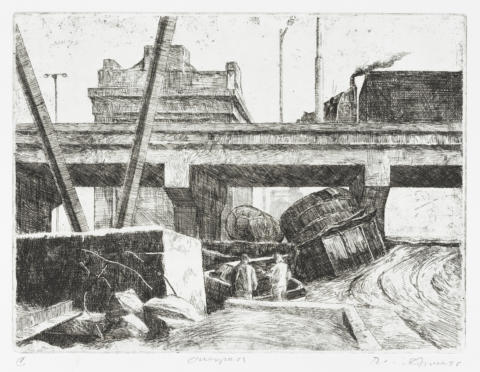
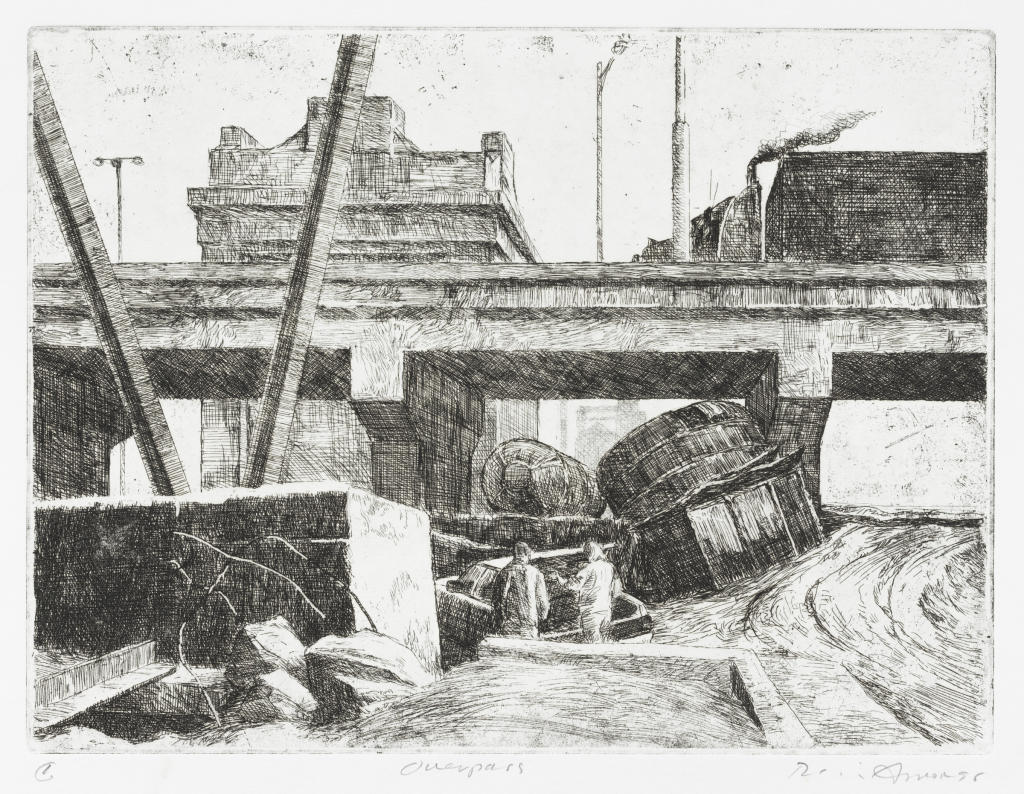
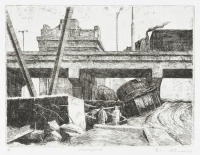
    Etching. View of an overpass that spans an area of unfinished road; in the foreground is builders’ rubble, in the midst of which stand two figures talking, behind a car. At the lower left is a concrete block from which emerge two metal trusses, forming a large V-shape. Beyond the overpass stands a tall Victorian building. A truck traverses the overpass from the right, its diesel chimney emitting smoke. To the left of the diesel chimney is a light pole. To the left of this is a truck’s exhaust pipe, thin and with an angled spout; it too releases smoke. The unmade road curves into the lower right corner. Foul biting is evident in many areas, especially in the lower part of the image and in the sky. There are two variant impressions of this state.

    1. Cleanly wiped impression on wove paper, printed by Rick Amor in his Alphington studio. Inscribed in pencil, below the plate mark: lower left: ‘1 [circled]’; lower centre: ‘Overpass’; lower right: signed and dated ‘Rick Amor 96’.
    2. Impression with plate tone, on wove paper, printed by Rick Amor in his Alphington studio. Inscribed in pencil, below the plate mark: lower left: ‘AP II/V’; lower centre: ‘Overpass’; lower right: signed and dated ‘Rick Amor 96’.
  • I.a. 1st state of 3

    Etching. View of an overpass that spans an area of unfinished road; in the foreground is builders’ rubble, in the midst of which stand two figures talking, behind a car. At the lower left is a concrete block from which emerge two metal trusses, forming a large V-shape. Beyond the overpass stands a tall Victorian building. A truck traverses the overpass from the right, its diesel chimney emitting smoke. To the left of the diesel chimney is a light pole. To the left of this is a truck’s exhaust pipe, thin and with an angled spout; it too releases smoke. The unmade road curves into the lower right corner. Foul biting is evident in many areas, especially in the lower part of the image and in the sky. There are two variant impressions of this state.

  • II. 2nd state of 3

    The angled, smoking spout of the thin exhaust pipe has been burnished away and the pipe now continues to the edge of the upper plate mark. The broken contour of the light pole to the right of the exhaust pipe is now continuous. The truck’s V-shaped aerial has also been completed.

    Dark impression with much plate tone, on wove paper, printed by Rick Amor in his Alphington studio. Inscribed in pencil, below the plate mark: lower left: ‘AP I/V’; lower centre: ‘Overpass’; lower right: signed and dated ‘Rick Amor 96’.

  • III. 3rd and final state

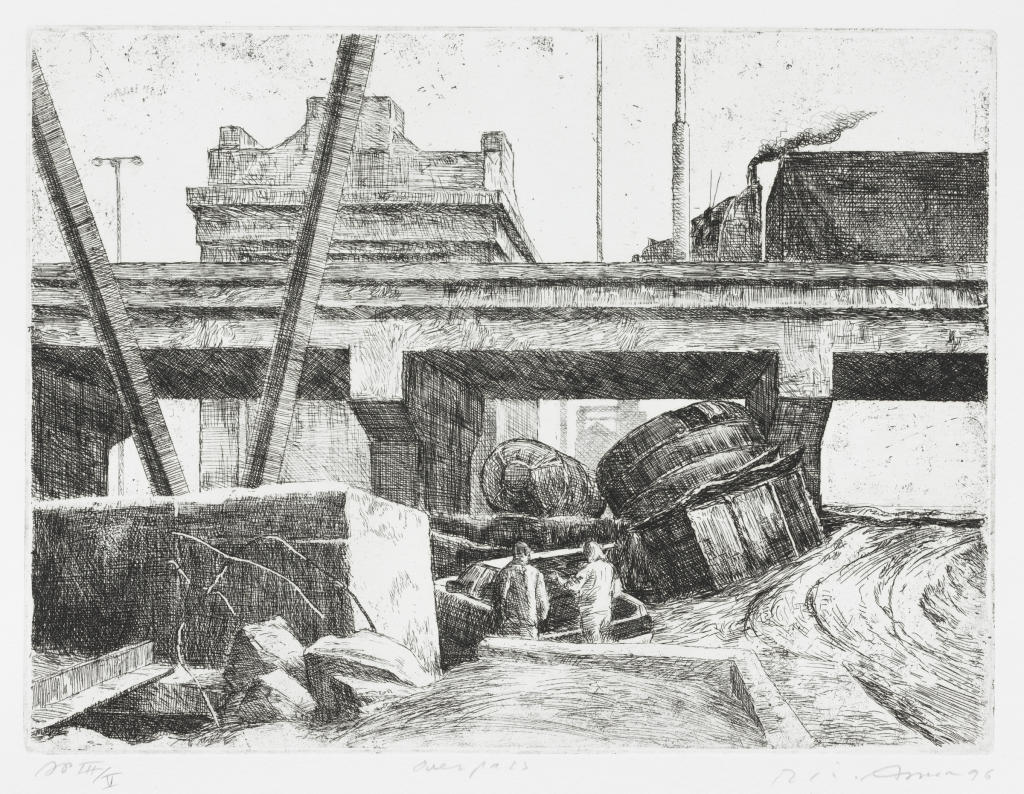
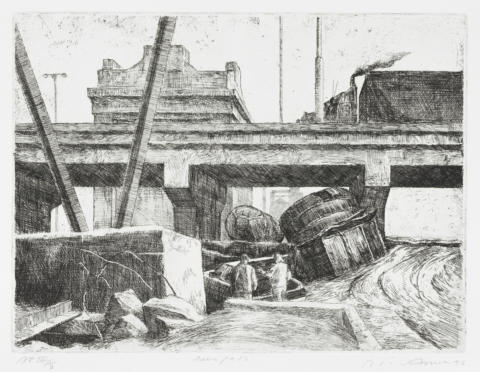
    The horizontally ridged tanks below the bridge have been burnished, so that they now appear more rounded; burnishing has also been applied to the middle band of the overpass. There are five variant impressions of this state.

    1. Cleanly wiped impression on wove BFK Rives paper, printed by Rick Amor in his Alphington studio. Inscribed in pencil, below the plate mark: lower left: ‘AP III/V’; lower centre: ‘Overpass’; lower right: signed and dated ‘Rick Amor 96’. (Featured Image)
    2. Impression on wove BFK Rives paper, printed by Rick Amor in his Alphington studio. Inscribed in pencil, below the plate mark: lower left: ‘AP IV/V’; lower centre: ‘Overpass’; lower right: signed and dated ‘Rick Amor 96’.
    3. Dark impression with plate tone, on wove BFK Rives paper, printed by Rick Amor in his Alphington studio. Inscribed in pencil, below the plate mark: lower left: ‘AP V/V’; lower centre: ‘Overpass’; lower right: signed and dated ‘Rick Amor 96’.
    4. Impression with plate tone, on wove BFK Rives paper with watermark, printed by Rick Amor in his Alphington studio. Inscribed in pencil, below the plate mark: lower left: ‘AP VI’; lower centre: ‘Overpass’; lower right: signed and dated ‘Rick Amor 96’.
    5. Cleanly wiped impression on wove BFK Rives paper with watermark, printed by Rick Amor in his Alphington studio. Inscribed in pencil, below the plate mark: lower left: ‘AP VII’; lower centre: ‘Overpass’; lower right: signed and dated ‘Rick Amor 96’.
  • III.a. Artist’s proof of 3rd and final state (Featured Image)
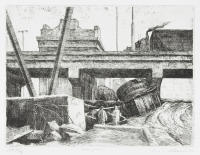
    The horizontally ridged tanks below the bridge have been burnished, so that they now appear more rounded; burnishing has also been applied to the middle band of the overpass. There are five variant impressions of this state.

  • Edition, 1996

    Nominal edition of ten, but only four impressions were printed and numbered. These are on wove paper and were printed by Rick Amor in his Alphington studio. Each impression is inscribed in pencil, below the plate mark: lower left: ‘[status of impression]’ [or] ‘[1 through 4]/10’; lower centre: ‘Overpass’; lower right: signed and dated ‘Rick Amor 96’.

    Edition sheet size: 380 × 432 mm

  • Comment

    This etching belongs to a group of closely related works dating from 1995 to 1998. The earliest of these is a watercolour painted in August 1995, Study for ‘Overpass’ (Niagara Galleries 1996), which differs from the etching in depicting in the distance not a nineteenth-century facade but a flat-topped building. The change to the building in the background was initiated in an oil, Study for ‘Overpass’, 1995 (Niagara Galleries 1996), in which the facade is based on that of the old Victoria Brewery, East Melbourne (built 1882). E.106 closely follows the painted study and is oriented in the same direction.

    The print was essentially completed in its first state, although the removal of the angled, smoking spout, which was burnished away in the second state, was a small but important change. The third and final state saw refinements of tone. The existence of five variant impressions of this state testifies to Amor’s ongoing interest in experimenting with plate tone and he continued to do this when printing the edition impressions.

Etching. View of an overpass that spans an area of unfinished road; in the foreground is builders’ rubble, in the midst of which stand two figures talking, behind a car. At the lower left is a concrete block from which emerge two metal trusses, forming a large V-shape. Beyond the overpass stands a tall Victorian building. A truck traverses the overpass from the right, its diesel chimney emitting smoke. To the left of the diesel chimney is a light pole. To the left of this is a truck’s exhaust pipe, thin and with an angled spout; it too releases smoke. The unmade road curves into the lower right corner. Foul biting is evident in many areas, especially in the lower part of the image and in the sky. There are two variant impressions of this state.

The horizontally ridged tanks below the bridge have been burnished, so that they now appear more rounded; burnishing has also been applied to the middle band of the overpass. There are five variant impressions of this state.

Catalogue Number
E.106
Title and Date
Overpass 1996
Description of Featured Image
View of an overpass that spans an area of unfinished road; in the foreground is builders’ rubble, in the midst of which stand two figures talking, behind a car. At the lower left is a concrete block from which emerge two metal trusses, forming a large V-shape. Beyond the overpass stands a tall Victorian building. A truck traverses the overpass from the right, its diesel chimney emitting smoke. To the left of the diesel chimney is a light pole. To the left of this is another, thin, truck’s exhaust pipe. The unmade road curves into the lower right corner.
Where Made
Alphington, Melbourne
Medium Category and Technique
Intaglio Print: Etching, foul biting and burnishing on copper
Support
Wove paper. Identified papers: BFK Rives paper with watermark: ‘BFK RIVES / FRANCE’ with infinity symbol.
Dimensions
Image size: 230 x 307 mm
Matrix size: 230 x 310 mm
Artist’s Record Number
RAE.113
Printer(s) and Workshop(s)
All impressions printed by Rick Amor in his Alphington studio.
Summary Edition Information
Three states. Nominal edition of ten, but only four impressions printed and numbered, 1996.
Exhibitions
Niagara Galleries at IWOP 1997: Niagara Galleries at the International Works on Paper Fair, Mitchell Galleries, State Library of New South Wales, Sydney, 17–­20 July 1997, no. 6.
Niagara Galleries 1998: Niagara Galleries, Richmond (Melbourne), Rick Amor, 22 September – 17 October 1998, no. 33, ed. 4/10.
Literature
For illustrations of two works closely related to E.106, see Niagara Galleries, Rick Amor (exh. cat.), Niagara Galleries, Richmond, Victoria, 1996, cat. no. 9 (Study for ‘Overpass’, 1995, watercolour), and cat. no. 13 (Study for ‘Overpass’, 1995, oil on canvas).
Collections
State Library of Victoria, Melbourne: one state impression, numbered 1; AP III/V.
Art Gallery of South Australia, Adelaide: ed. 1/10, mistakenly dated 1991 by the artist (20155G142).
National Gallery of Victoria, Melbourne: ed. 3/10, with plate tone (2012.410).
Comment

This etching belongs to a group of closely related works dating from 1995 to 1998. The earliest of these is a watercolour painted in August 1995, Study for ‘Overpass’ (Niagara Galleries 1996), which differs from the etching in depicting in the distance not a nineteenth-century facade but a flat-topped building. The change to the building in the background was initiated in an oil, Study for ‘Overpass’, 1995 (Niagara Galleries 1996), in which the facade is based on that of the old Victoria Brewery, East Melbourne (built 1882). E.106 closely follows the painted study and is oriented in the same direction.

The print was essentially completed in its first state, although the removal of the angled, smoking spout, which was burnished away in the second state, was a small but important change. The third and final state saw refinements of tone. The existence of five variant impressions of this state testifies to Amor’s ongoing interest in experimenting with plate tone and he continued to do this when printing the edition impressions.

Keywords
City, Overpass, Roadworks, Truck
URL
https://catalogue.rickamor.com.au/works/intaglio/the-overpass/

Record last updated 16/02/2021
Previous
Next
  • About
  • Self portrait
  • Home
  • Home
  • Chronology
  • Interior
  • About
  • Acknowledgements
  • Contact
  • Catalogue
  • Guide to Entries
  • Man
  • Selected Bibliography
  • Guide to Entries
  • Selected Exhibitions
  • Contact
  • Collections
  • Printers & Workshops
  • The Project Team or Who Did What
  • Acknowledgements
  • Links
Copyright Rick Amor 2025.