Rick Amor

An Online Catalogue Raisonné of the Prints by Irena Zdanowicz

  • About
  • Self portrait
  • Home
  • Home
  • Chronology
  • Interior
  • About
  • Acknowledgements
  • Contact
  • Catalogue
  • Guide to Entries
  • Man
  • Selected Bibliography
  • Guide to Entries
  • Selected Exhibitions
  • Contact
  • Collections
  • Printers & Workshops
  • The Project Team or Who Did What
  • Acknowledgements
  • Links
  • Home
  • Catalogue
  • The chambers (facade)

The chambers (facade) 2002; reworked and retitled 2006

Previous
Next

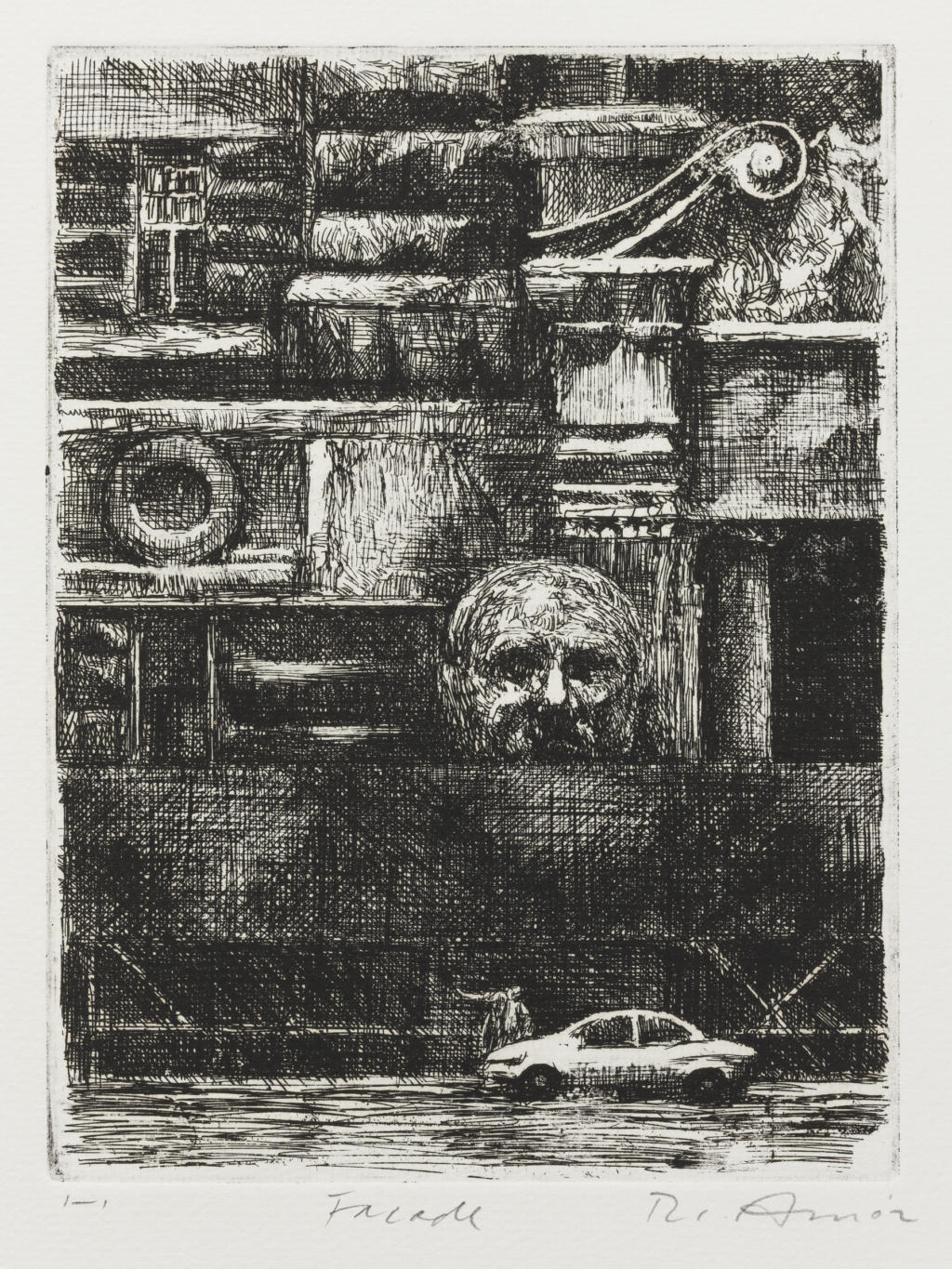
I.a. 1st state of 5, 2002, as Facade
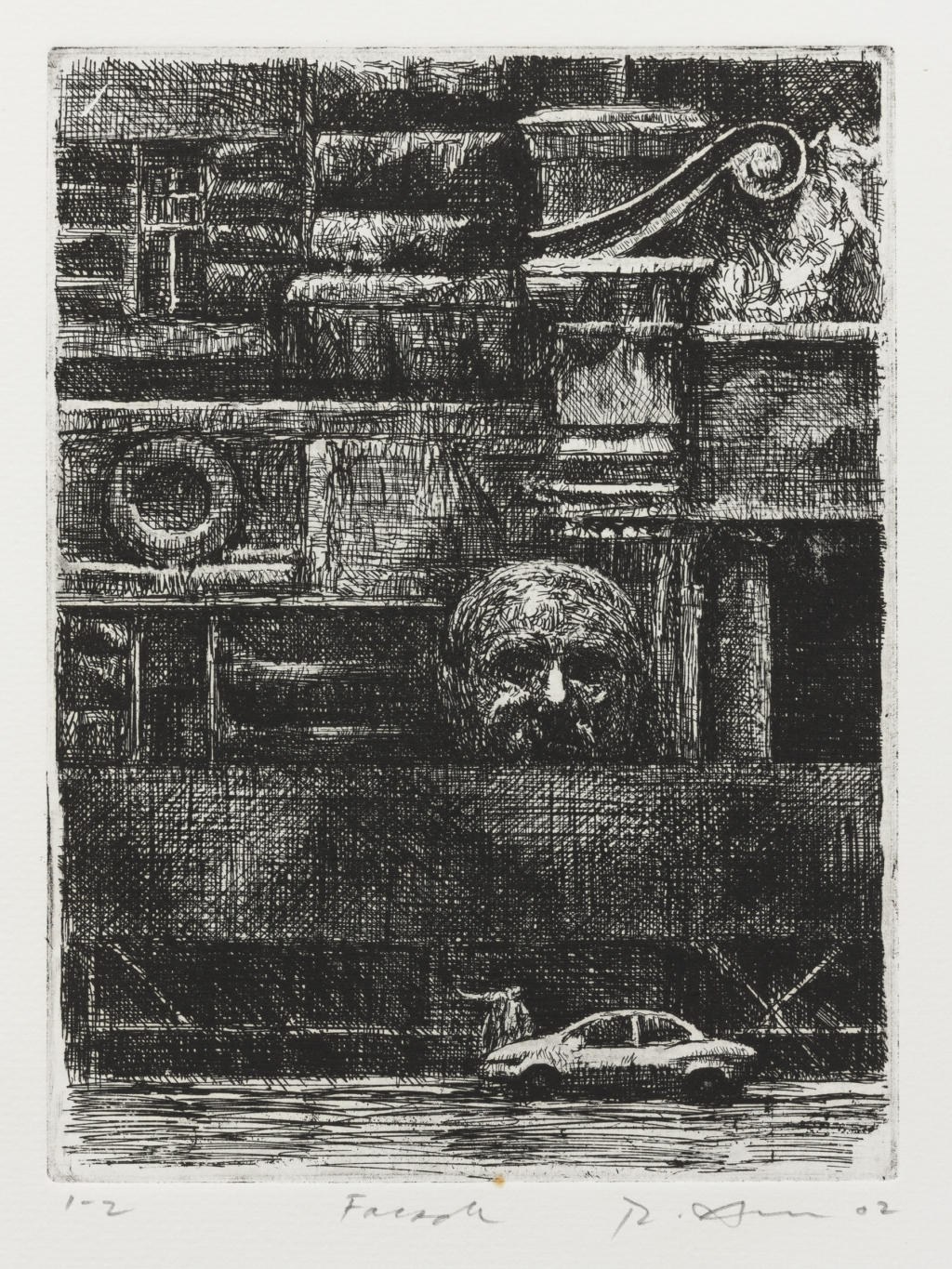
II. 2nd state of 5, 2002, as Facade
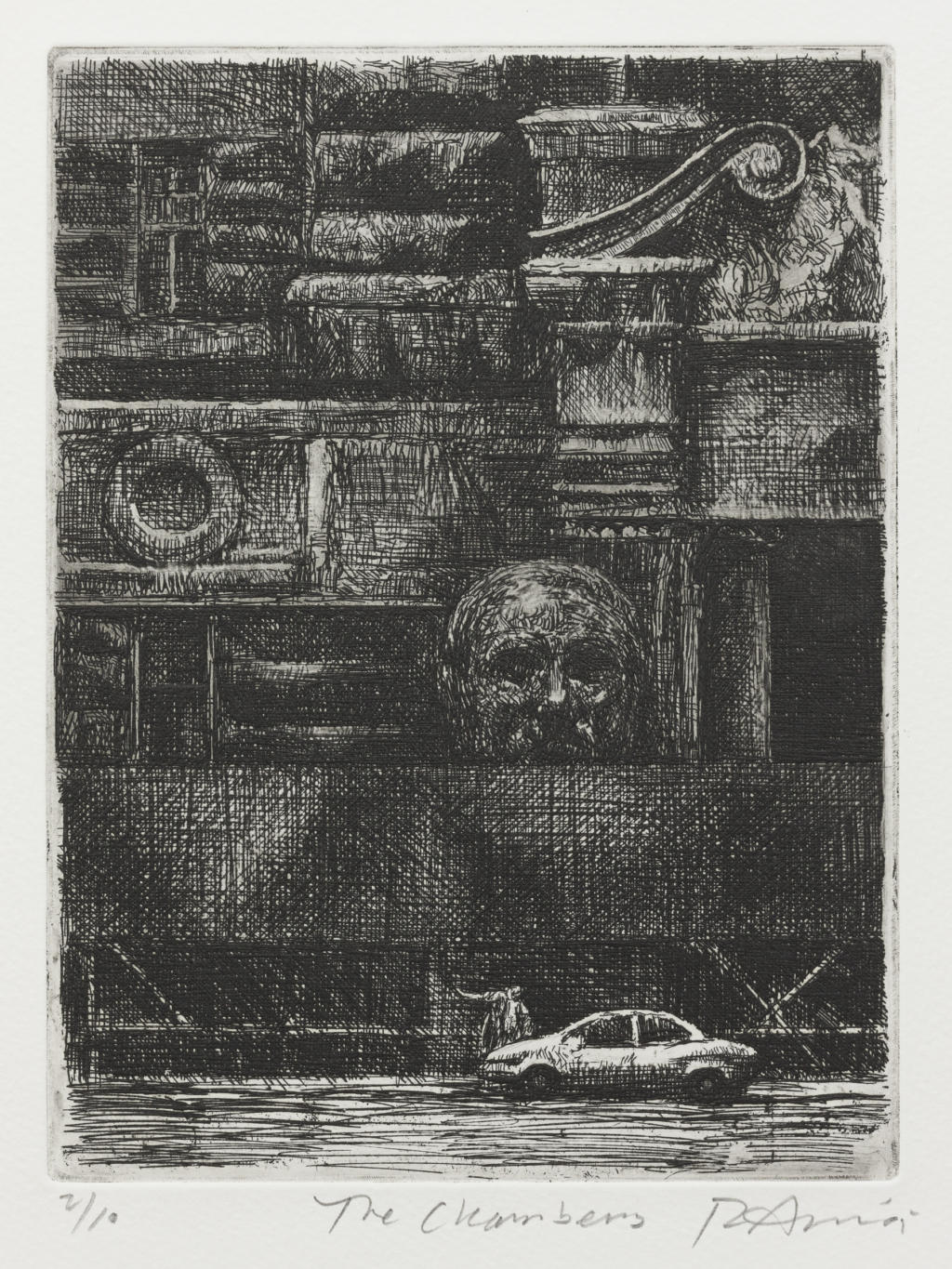
Edition impression (first edition, 2005), as The chambers (Featured Image)
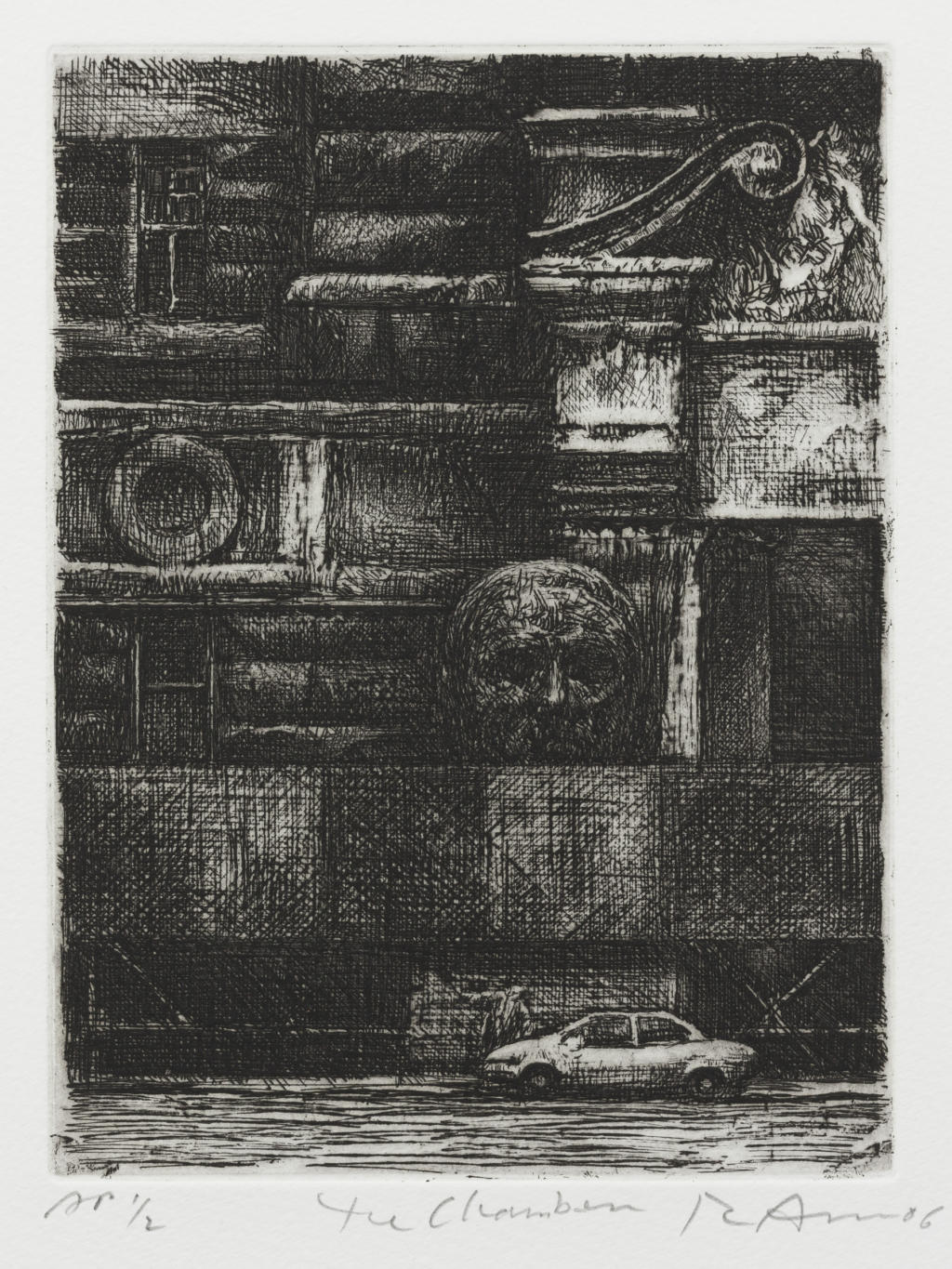
Artist’s proof (from second edition, 2006; impression of 5th and final state)
Close the overlay

E.126 The chambers (facade) 2002; reworked and retitled 2006

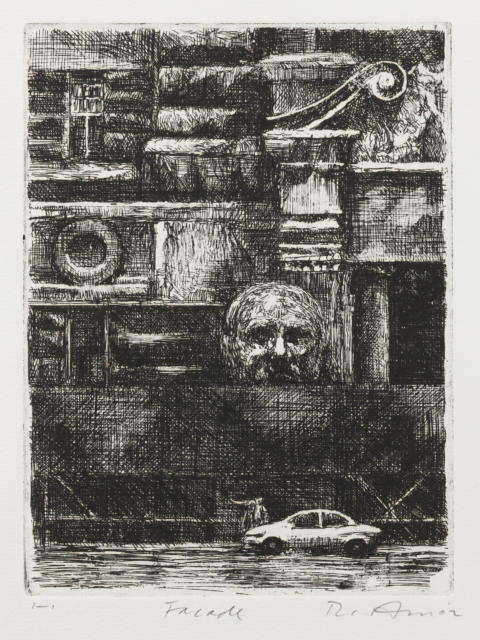
  • I. 1st state of 5, 2002, as Facade

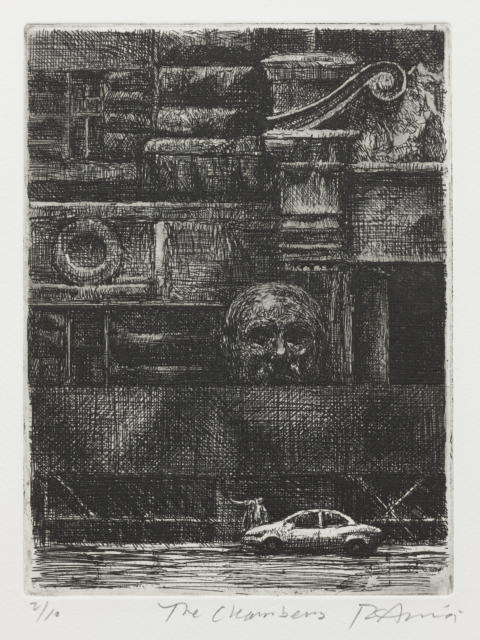
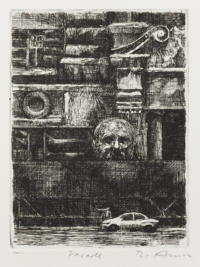
    Etching. A street view showing a city building behind a hoarding, its rusticated facade filled with classical ornament and a giant sculptured head. In front of the hoarding is a car, whose unseen occupant is being given directions by a man who points leftward with his outstretched arm. There are four variant impressions of this state.

    1. Cleanly wiped impression, on wove Magnani paper, printed by Rick Amor in his Alphington studio. Inscribed in pencil, below the plate mark: lower left: ‘1-1’; lower centre: ‘Facade’; lower right: signed and dated ‘Rick Amor ’02’.
    2. Impression with plate tone, on wove Magnani paper with watermark, printed by Rick Amor in his Alphington studio. Inscribed in pencil, below the plate mark: lower left: ‘2-1’; lower centre: ‘Facade’; lower right: signed and dated ‘Rick Amor ’02’.
    3. Dark, selectively wiped impression with plate tone across the lower half of the plate, on wove Magnani paper with watermark, printed by Rick Amor in his Alphington studio. Inscribed in pencil, below the plate mark: lower left: ‘3-1’; lower centre: ‘Facade’; lower right: signed and dated ‘Rick Amor ’02’. The plate tone across the lower half of the plate obscures the face of the sculptured head.
    4. Cleanly wiped impression on wove Magnani paper, printed by Rick Amor in his Alphington studio. Inscribed in pencil, below the plate mark: lower left: ‘4-1’; lower centre: ‘Facade’; lower right: signed and dated ‘Rick Amor ’02’.
  • I.a. 1st state of 5, 2002, as Facade

    Etching. A street view showing a city building behind a hoarding, its rusticated facade filled with classical ornament and a giant sculptured head. In front of the hoarding is a car, whose unseen occupant is being given directions by a man who points leftward with his outstretched arm. There are four variant impressions of this state.

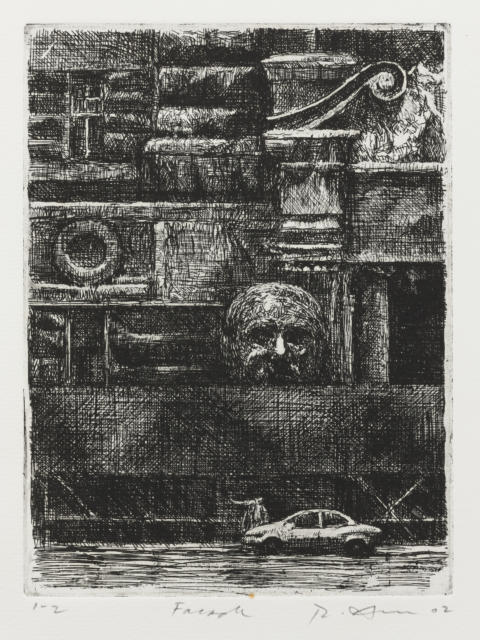
  • II. 2nd state of 5, 2002, as Facade

    Much new etching has been applied throughout the plate in order to tone down the white highlights; it is as if a shadow has fallen across the building. The car is now modelled with greater detail.

    Impression with light plate tone, on wove Magnani paper with watermark, printed by Rick Amor in his Alphington studio. Inscribed in pencil, below the plate mark: lower left: ‘1-2’; lower centre: ‘Facade’; lower right: signed and dated ‘Rick Amor ’02’.

  • III. 3rd state of 5, 2002, as Facade

    Etched lines have been added to the nose of the sculptured head to subdue the tonal contrast.

    Cleanly wiped impression, but with faint plate tone around the edges, on wove Magnani paper with watermark, printed by Rick Amor in his Alphington studio. Inscribed in pencil, below the plate mark: lower left: ‘1-3’; lower centre: ‘Facade’; lower right: signed and dated ‘Rick Amor ’02’.

  • IV. 4th state of 5, 2002, as Facade

    Light has been restored with the burnishing back of the etched shading applied to some of the highlights across the plate in the second state. This is particularly evident in the area of the entablature to the upper right of the sculptured head and to its immediate left. Nonetheless, the details of the face have been subdued with more etching, apparent especially on the nose. The hoarding has also been burnished in places. There are three variant impressions of this state.

    1. Cleanly wiped impression on wove paper, printed by Rick Amor in his Alphington studio. Inscribed in pencil, below the plate mark: lower left: ‘1-4’; lower centre: ‘Facade’; lower right: signed and dated ‘Rick Amor ’02’.
    2. Cleanly wiped impression on a different wove paper than that used for IV.a, printed by Rick Amor in his Alphington studio. Inscribed in pencil, below the plate mark: lower left: ‘2-4’; lower centre: ‘Facade’; lower right: signed and dated ‘Rick Amor ’02’.
    3. Impression with faint plate tone, on yet another kind of wove paper, printed by Rick Amor in his Alphington studio. Inscribed in pencil, below the plate mark: lower left: ‘3-4’; lower centre: ‘Facade’; lower right: signed and dated ‘Rick Amor ’02’.
  • First edition, 2005, as The chambers

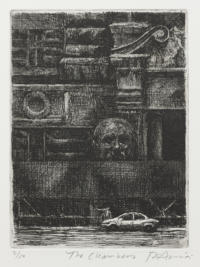
    Edition of ten numbered impressions, on wove Velin Arches paper, printed by Rosalind Atkins at the Australian Print Workshop, Fitzroy (Melbourne), September 2005. The edition included a bon à tirer impression, an artist’s proof and two APW workshop proofs. Each impression is inscribed in pencil, below the plate mark: lower left: ‘[status of impression]’ [or] ‘[1 through 10]/10’; lower centre: ‘The Chambers’; lower right: signed and dated ‘Rick Amor ’05’. APW chop mark in lower right corner: ‘APW [within rectangle]’. The edition is uniformly printed with a light film of plate tone.

    Edition sheet size: 380 x 285 mm

  • Edition impression (first edition, 2005), as The chambers (Featured Image)

    Light has been restored with the burnishing back of the etched shading applied to some of the highlights across the plate in the second state. This is particularly evident in the area of the entablature to the upper right of the sculptured head and to its immediate left. Nonetheless, the details of the face have been subdued with more etching, apparent especially on the nose. The hoarding has also been burnished in places.

  • V. 5th and final state, 2006, as The chamber

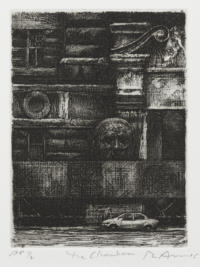
    The plate has been extensively burnished in select areas across the entire image, and re-etched with an accompanying addition of etched detail, including on the brow of the sculptured head. The burnishing reveals the geometry of the building’s facade and this extends to the hoarding, which now has alternating vertical bands of dark and light tone. A rectangular area has been burnished behind the pointing figure. The title is now The chamber.

    Impression on wove paper, printed by Rick Amor in his Alphington studio. Inscribed in pencil, below the plate mark: lower left: ‘1-1’; lower centre: ‘The Chamber’; lower right: signed and dated ‘Rick Amor ’06’.

  • Second edition, 2006

    Edition of thirty numbered impressions on wove Somerset paper, printed by Andrew Gunnell at Chrysalis Publishing Studio, East Melbourne. The edition included seven artist’s proofs and an hors commerce impression, later hand-coloured in watercolour by the artist. Each impression is inscribed in pencil, below the plate mark: lower left: ‘[status of impression]’ [or] ‘[1 through 30]/30’; lower centre: ‘The Chamber’; lower right: signed and dated ‘Rick Amor ’06’.

    Edition sheet size: 400 x 390 mm

  • Artist’s proof (from second edition, 2006; impression of 5th and final state)
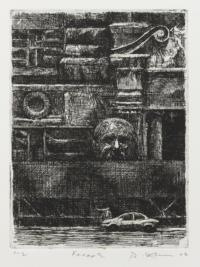
    The plate has been extensively burnished in select areas across the entire image, and re-etched with an accompanying addition of etched detail, including on the brow of the sculptured head. The burnishing reveals the geometry of the building’s facade and this extends to the hoarding, which now has alternating vertical bands of dark and light tone. A rectangular area has been burnished behind the pointing figure. The title is now The chamber.

  • Comment

    This etching is based on an oil titled The chambers, 2002, but is in reverse direction and omits the tall tree seen at the right in the painted composition (Lindsay 2005). Amor found his initial inspiration in a building belonging to New York University, in Irving Place, New York, but he changed its proportions and some of its decorative features, combining them with elements of public architecture closer to home: the state Parliament Houses in Melbourne and Sydney. The giant head in the print harks back to imperial Roman sculpture, the architectural fantasies of Piranesi, and – less distant in time – Fascist monuments. Amor himself sees the head as an evocation of Orwell’s Big Brother.

    The initial version of the etching (2002–05) was conceived in tonal terms, with a progressive darkness threatening to overwhelm the subject. However, burnishing in the fifth and final state brought the etching closer to its genesis in the painting of 2002. The geometry of the facade became clearer and the hoarding lost its uninterrupted surface, to become, instead, composed of square panels, as in the painting.

    Of the painting, Robert Lindsay has written: ‘The shroud-like scaffolding encases an historical building which is part of New York University, while the source of the Fascist sculpture is Italy. Amor here speculates on the origins of both and the inevitable march of time through which the patron and the identity of the sculpture have been long forgotten, again the leitmotif [is] vanitas’ (Lindsay 2005).

Etching. A street view showing a city building behind a hoarding, its rusticated facade filled with classical ornament and a giant sculptured head. In front of the hoarding is a car, whose unseen occupant is being given directions by a man who points leftward with his outstretched arm. There are four variant impressions of this state.

Much new etching has been applied throughout the plate in order to tone down the white highlights; it is as if a shadow has fallen across the building. The car is now modelled with greater detail.

Light has been restored with the burnishing back of the etched shading applied to some of the highlights across the plate in the second state. This is particularly evident in the area of the entablature to the upper right of the sculptured head and to its immediate left. Nonetheless, the details of the face have been subdued with more etching, apparent especially on the nose. The hoarding has also been burnished in places.

The plate has been extensively burnished in select areas across the entire image, and re-etched with an accompanying addition of etched detail, including on the brow of the sculptured head. The burnishing reveals the geometry of the building’s facade and this extends to the hoarding, which now has alternating vertical bands of dark and light tone. A rectangular area has been burnished behind the pointing figure. The title is now The chamber.

Catalogue Number
E.126
Title and Date
The chambers (facade)

2002; reworked and retitled 2006

Subsequent Title(s)
The chamber
Description of Featured Image
A street view showing a city building behind a hoarding, its rusticated facade filled with classical ornament and a giant sculptured head. In front of the hoarding is a car, whose unseen occupant is being given directions by a man who points leftward with his outstretched arm.
Where Made
Alphington, Melbourne
Medium Category and Technique
Intaglio Print: Etching and burnishing on copper
Support
Wove paper. Identified papers: Magnani paper with watermark: Romanesque ‘M’ with cross above; Velin Arches paper; Somerset paper.
Dimensions
Image size: 200 x 148 mm
Matrix size: 200 x 148 mm
Artist’s Record Number
RAE.143 (2002, 2005), RAE.161 (2006)
Printer(s) and Workshop(s)
All state impressions printed by Rick Amor in his Alphington studio. First edition printed by Rosalind Atkins at the Australian Print Workshop, Fitzroy (Melbourne). Second edition printed by Andrew Gunnell at Chrysalis Publishing Studio, East Melbourne.
Summary Edition Information
Five states. Two editions. First edition: edition of ten numbered impressions, 2005 (The chambers). Second edition: edition of thirty numbered impressions, 2006 (The chamber).
Exhibitions
University of Melbourne 2014: Ian Potter Museum of Art, University of Melbourne, Parkville (Melbourne), The Piranesi Effect, 20 February – 25 May 2014, no. 36 (2006).
Literature
Robert Lindsay, Rick Amor: Standing in the Shadows (exh. cat.), McClelland Gallery and Sculpture Park, Langwarrin, Victoria, 2005, p. 11. For an illustration of the painting The chambers, 2002, see cat. no. 63, p. 74. 
Gavin Fry, Rick Amor, Beagle Press, Roseville, NSW, 2008, p. 133.
Collections
State Library of Victoria, Melbourne: ten state impressions, numbered 1-1 through 1-4, 2-1, 2-4, 3-1, 3-4, 4-1, 4-4, all dated 2002 (as Facade); ed. 2/10, dated 2005 (as The chambers); one state impression, numbered 1-1, dated 2006 (The chamber); AP 1/2, AP 2/2, both dated 2006 (The chamber).
National Gallery of Australia, Canberra: ed. 1/10, dated 2005 (as The chambers) (2007.709).
Comment

This etching is based on an oil titled The chambers, 2002, but is in reverse direction and omits the tall tree seen at the right in the painted composition (Lindsay 2005). Amor found his initial inspiration in a building belonging to New York University, in Irving Place, New York, but he changed its proportions and some of its decorative features, combining them with elements of public architecture closer to home: the state Parliament Houses in Melbourne and Sydney. The giant head in the print harks back to imperial Roman sculpture, the architectural fantasies of Piranesi, and – less distant in time – Fascist monuments. Amor himself sees the head as an evocation of Orwell’s Big Brother.

The initial version of the etching (2002–05) was conceived in tonal terms, with a progressive darkness threatening to overwhelm the subject. However, burnishing in the fifth and final state brought the etching closer to its genesis in the painting of 2002. The geometry of the facade became clearer and the hoarding lost its uninterrupted surface, to become, instead, composed of square panels, as in the painting.

Of the painting, Robert Lindsay has written: ‘The shroud-like scaffolding encases an historical building which is part of New York University, while the source of the Fascist sculpture is Italy. Amor here speculates on the origins of both and the inevitable march of time through which the patron and the identity of the sculpture have been long forgotten, again the leitmotif [is] vanitas’ (Lindsay 2005).

Keywords
Cityscapes & streetscapes, George Orwell, New York, Piranesi
URL
https://catalogue.rickamor.com.au/works/intaglio/the-chambers/

Record last updated 16/02/2021
Previous
Next
  • About
  • Self portrait
  • Home
  • Home
  • Chronology
  • Interior
  • About
  • Acknowledgements
  • Contact
  • Catalogue
  • Guide to Entries
  • Man
  • Selected Bibliography
  • Guide to Entries
  • Selected Exhibitions
  • Contact
  • Collections
  • Printers & Workshops
  • The Project Team or Who Did What
  • Acknowledgements
  • Links
Copyright Rick Amor 2025.