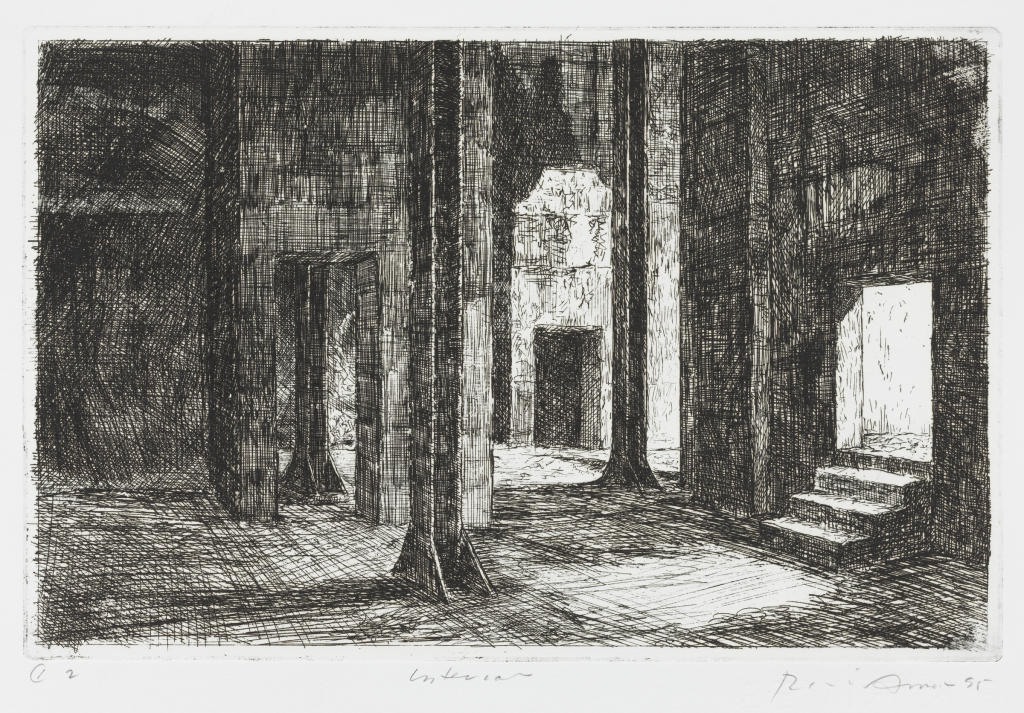
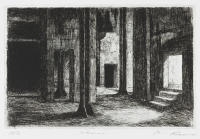
I.b. 1st state of 2
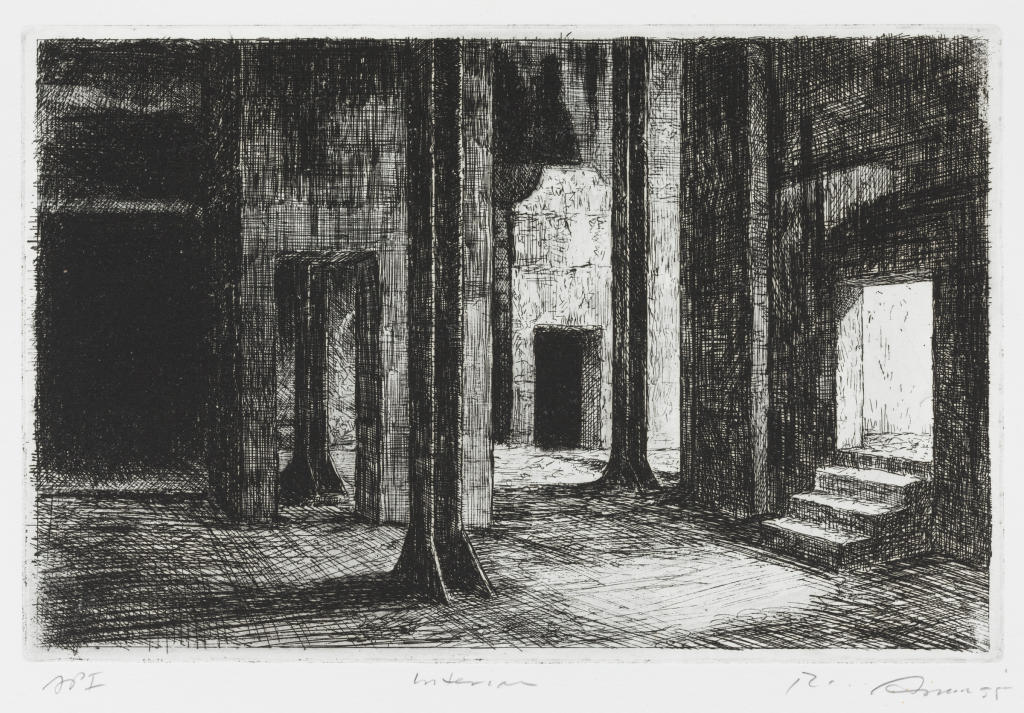
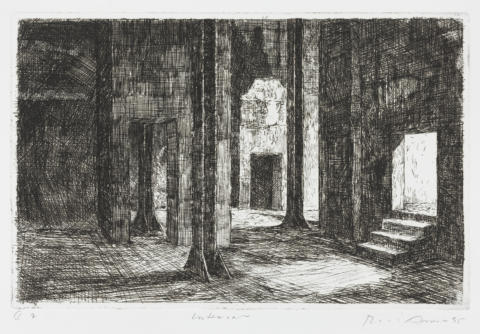
II. 2nd and final state (Featured Image)
E.099 Interior 1995
I.b. 1st state of 2
Etching. The setting here is a large, empty industrial interior, whose space is dominated by three steel truss columns and a central internal enclosed area. There are three doorways in this image: one at the centre left that leads into the enclosed area; one in the far right distance; and one at the centre right, through which light floods, illuminating the three steps that lead down into the interior. The various elements of the composition have been rendered chiefly with etched cross-hatching, but there are irregular etched squiggles in the light areas. There are three variant impressions of this state.
II. 2nd and final state (Featured Image)
Much new work in drypoint has been added, especially in the area at left, which is now clearly a dark doorway. In addition, the shadows and dark areas of the doorway in the far right distance have been deepened, and drypoint accents have been introduced around the doorway at the right.
Impression with faint plate tone, on wove paper, printed by Rick Amor in his Alphington studio. Inscribed in pencil, below the plate mark: lower left: ‘AP I’; lower centre: ‘Interior’; lower right: signed and dated ‘R. Amor ’95’.
Etching. The setting here is a large, empty industrial interior, whose space is dominated by three steel truss columns and a central internal enclosed area. There are three doorways in this image: one at the centre left that leads into the enclosed area; one in the far right distance; and one at the centre right, through which light floods, illuminating the three steps that lead down into the interior. The various elements of the composition have been rendered chiefly with etched cross-hatching, but there are irregular etched squiggles in the light areas. There are three variant impressions of this state.
Much new work in drypoint has been added, especially in the area at left, which is now clearly a dark doorway. In addition, the shadows and dark areas of the doorway in the far right distance have been deepened, and drypoint accents have been introduced around the doorway at the right.
- Catalogue Number
- E.099
- Title and Date
- Interior 1995
- Description of Featured Image
- The setting here is a large, empty industrial interior, whose space is dominated by three steel truss columns and a central internal enclosed area. There are multiple doorways in this image: one at the left – a rectangle of deep blackness; one at the centre left that leads into the enclosed area; one in the far right distance; and one at the centre right, through which light floods, illuminating the three steps that lead down into the interior.
- Where Made
- Alphington, Melbourne
- Medium Category and Technique
- Intaglio Print: Etching and drypoint on copper
- Support
- Wove paper. Identified papers: BFK Rives paper with watermark: ‘BFK RIVES / FRANCE’ with infinity symbol.
- Dimensions
-
Image size: 197 x 305 mm
Matrix size: 200 x 305 mm - Artist’s Record Number
- RAE.103
- Printer(s) and Workshop(s)
- All impressions printed by Rick Amor in his Alphington studio.
- Summary Edition Information
- Two states. Nominal edition of ten, but only five impressions printed and numbered, 1995.
- Collections
- State Library of Victoria, Melbourne: three state impressions, numbered 1/1 through 1/3; ed. 3/10.
- National Gallery of Australia, Canberra: ed. 1/10 (2007.636).
- Comment
The interior depicted in E.099 is based on a space in the old Victoria Brewery, in Victoria Parade, East Melbourne. Built in 1882, the brewery has in more recent years been redeveloped as the Tribeca Apartments, which opened in 2007. Rick Amor had permission to explore the building during demolition works.
The composition of this print was fully resolved in the first state, although the three variant impressions of this state signal Amor’s wish to experiment with dark effects. The drypoint tone and lines added in the second state deepened the overall tonality, and the darkness of mood, while also serving to clarify architectural detail. Amor continued his experimentation with mood and tone when printing a partial edition of the etching, as, from impression to impression, he varied the process of inking and wiping the plate.
The black door or doorway, which has such a prominent role in the composition of E.099, has been an important motif in Amor’s art.
- Keywords
- Building interior, Interior
- URL
- https://catalogue.rickamor.com.au/works/intaglio/interior/
Record last updated 15/02/2021