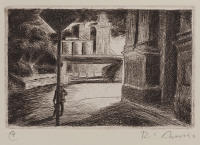
I. 1st state of 7
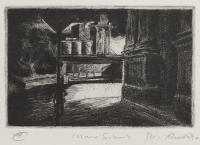
II.b. 2nd state of 7
II.b. 2nd state of 7
V. 5th state of 7
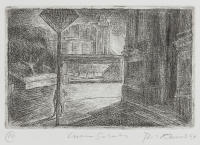
VI. 6th state of 7
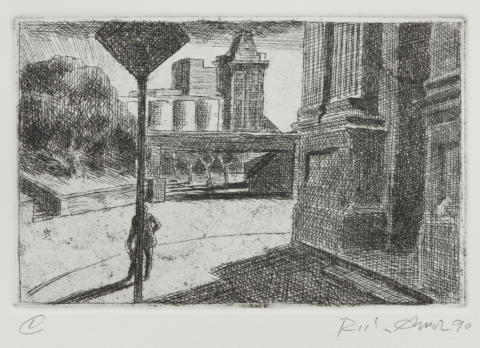
VII. 7th and final state (Featured Image)
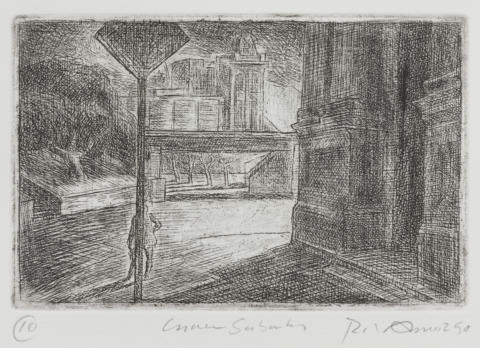
E.032 Inner suburb 1990
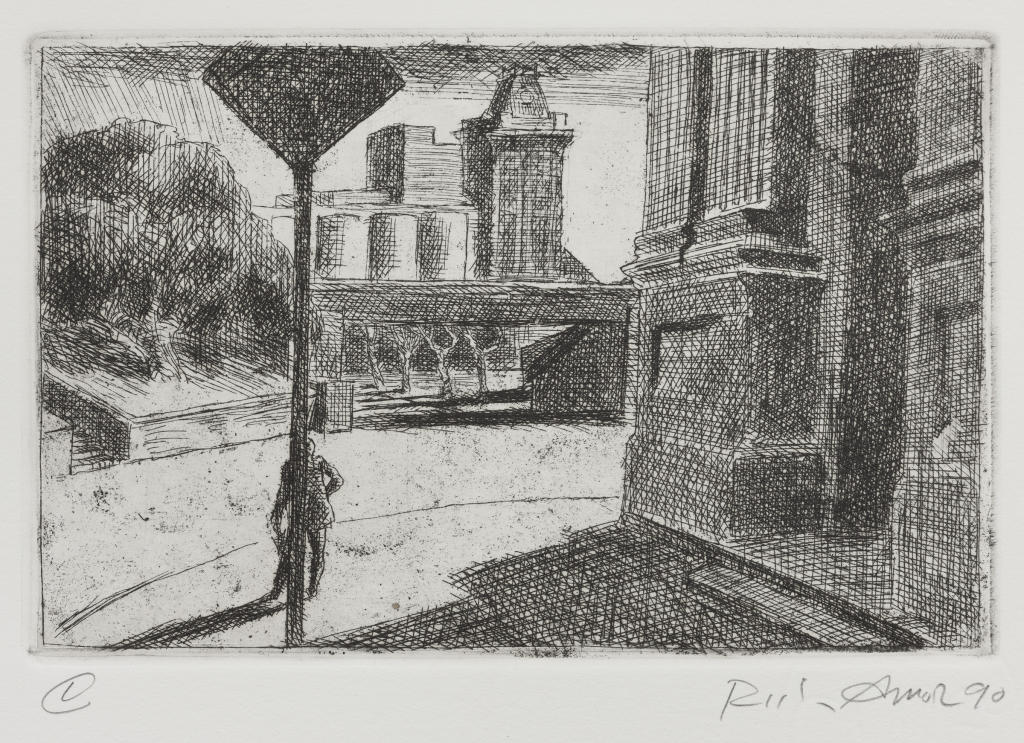
I. 1st state of 7
Etching. A view from above of an inner-suburban street junction, with the corner of a nineteenth-century building at right, and a railway bridge over the road in the middle distance; beyond the bridge are silos and a nineteenth-century tower. At the mid left is a treed embankment. Prominent in the left foreground is a standing man, who is partially obscured by a tall pole supporting a diamond-shaped street sign. The man’s long shadow falls to the left, and the roadway in front of him is blank, although pitted with foul biting. The basic composition is complete and is lightly etched, with cross-hatching.
Impression on wove Fabriano paper with watermark, printed by Rick Amor in his Dunmoochin studio. Inscribed in pencil, below the plate mark: lower left: ‘1 [circled]’; lower right: signed and dated ‘Rick Amor 90’.
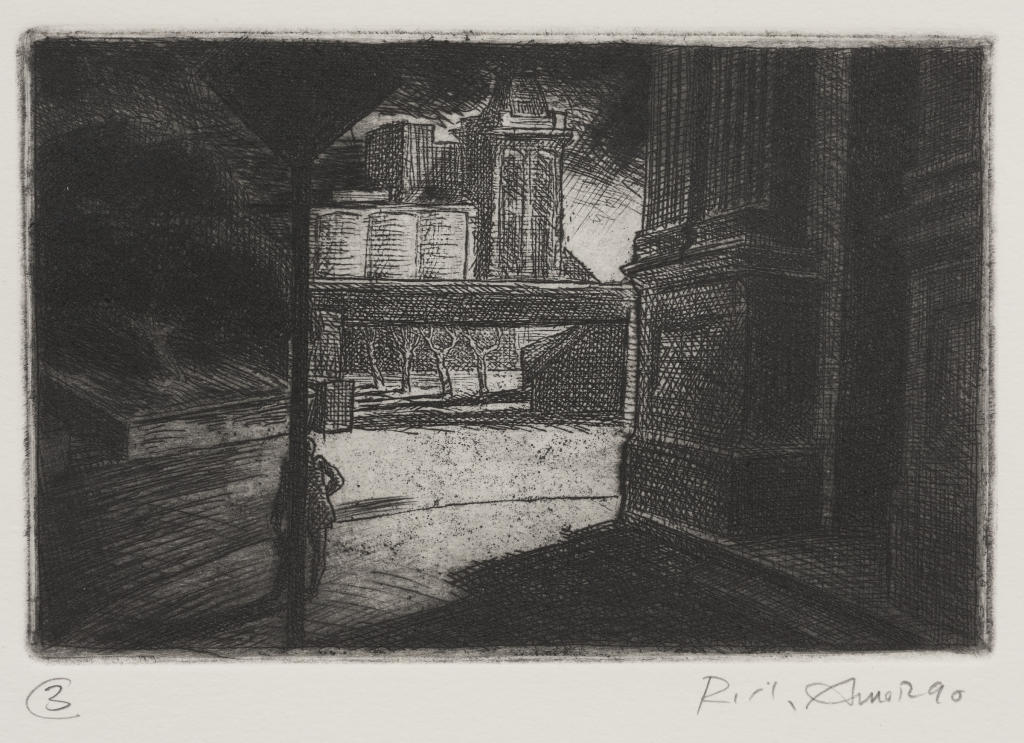
II.b. 2nd state of 7
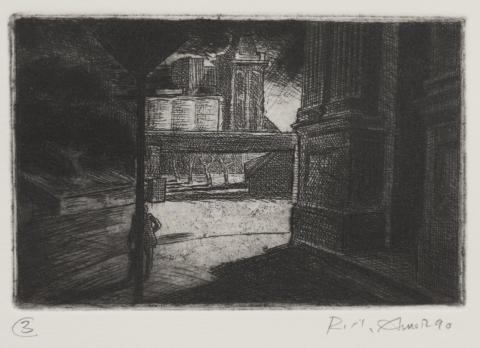
Drypoint has been added throughout the plate, to create a scene of dramatically contrasting areas of light and dark. The road to the left of the man is now darkened with curved parallel drypoint hatching. The three cylindrical silos in the distance have been burnished. There are three variant impressions of this state.
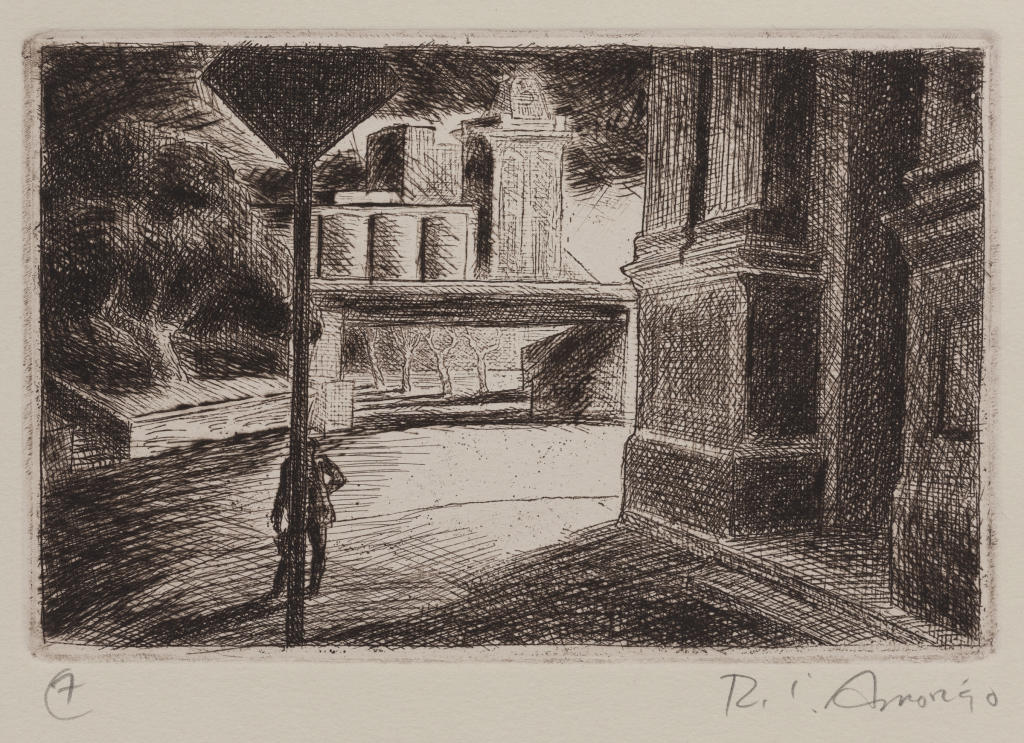
V. 5th state of 7
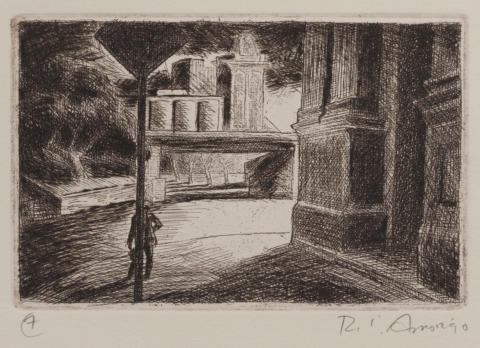
Drypoint accents have been added throughout to increase the contrasts between light and dark and to enhance the sense of space.
Impression in brown ink, on buff wove paper, printed by Rick Amor in his Dunmoochin studio. Inscribed in pencil, below the plate mark: lower left: ‘7 [circled]’; lower right: signed and dated ‘Rick Amor ’90’. Although inscribed ‘7’, this is the fifth state.
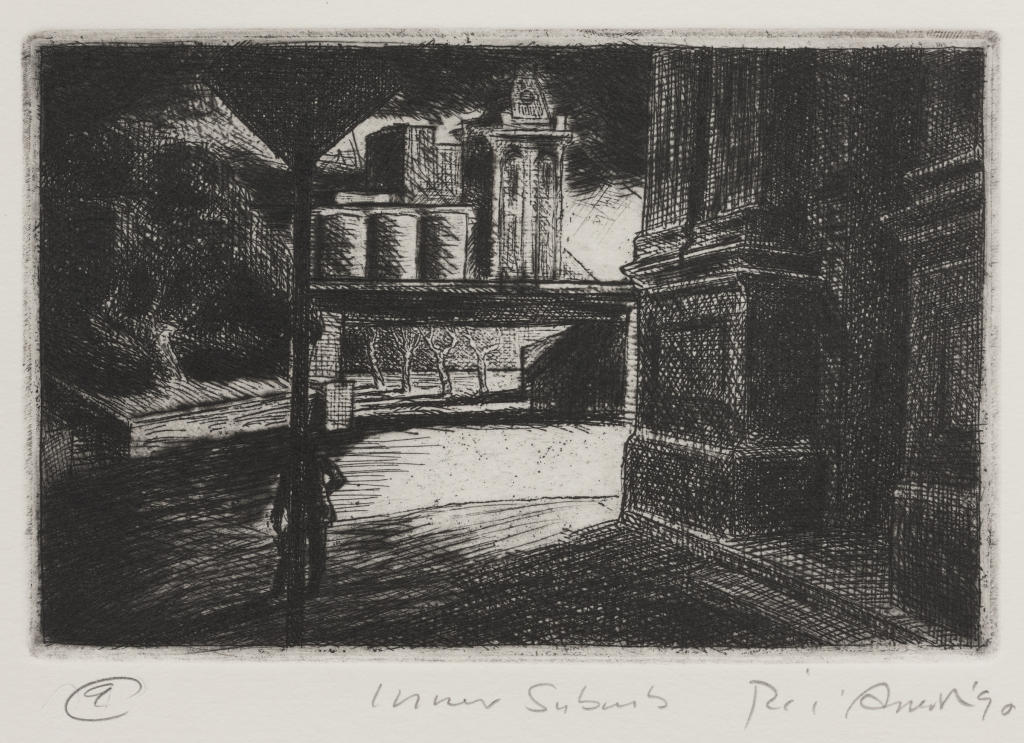
VI. 6th state of 7
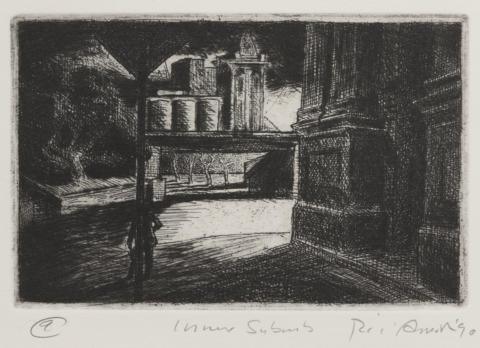
Drypoint lines have been extended into the area immediately to the right of the figure, and touches of drypoint have been added to the tower. The figure is now a black silhouette, with the barest indication of light on the clothing at the right.
Impression with plate tone and rich burr, on cream wove Stonehenge paper (according to Amor’s intaglio record books), printed by Rick Amor in his Dunmoochin studio. Inscribed in pencil, below the plate mark: lower left: ‘9 [circled]’; lower centre: ‘Inner Suburb’; lower right: signed and dated ‘Rick Amor ’90’. Although inscribed ‘9’, this is the sixth state.
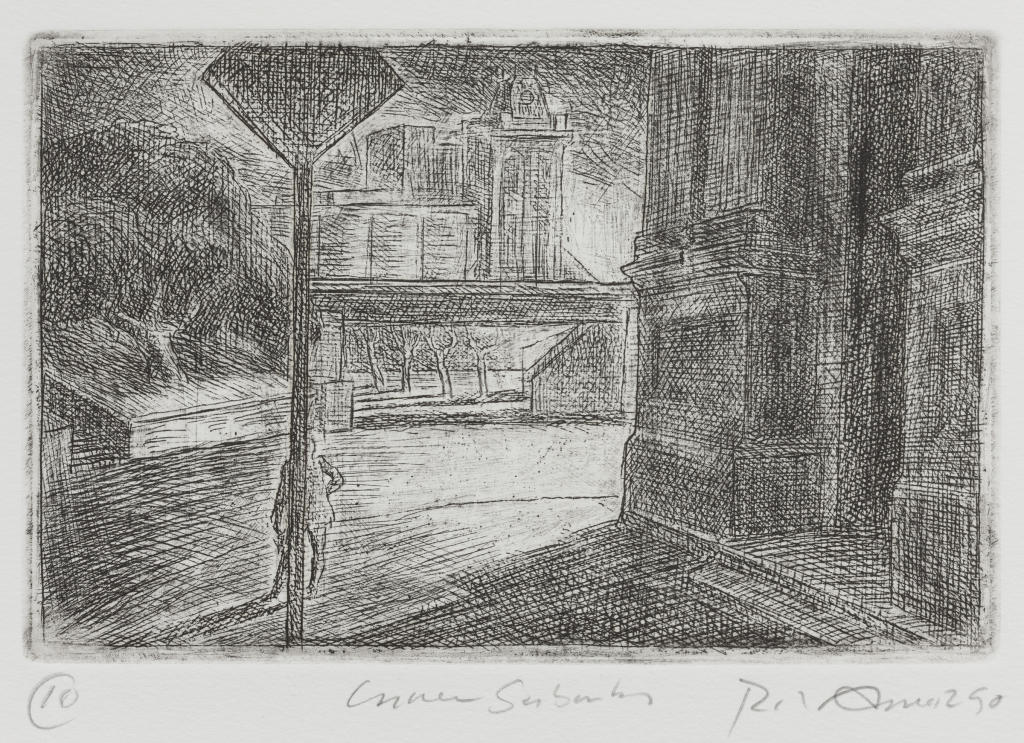
VII. 7th and final state (Featured Image)
The plate has been scraped back and burnished evenly, resulting in a ghostly image.
Light, cleanly wiped impression on wove paper, printed by Rick Amor in his Dunmoochin studio. Inscribed in pencil, below the plate mark: lower left: ‘10 [circled]’; lower centre: ‘Inner Suburb’; lower right: signed and dated ‘Rick Amor 90’. Although inscribed ‘10’, this is the seventh and final state.
Etching. A view from above of an inner-suburban street junction, with the corner of a nineteenth-century building at right, and a railway bridge over the road in the middle distance; beyond the bridge are silos and a nineteenth-century tower. At the mid left is a treed embankment. Prominent in the left foreground is a standing man, who is partially obscured by a tall pole supporting a diamond-shaped street sign. The man’s long shadow falls to the left, and the roadway in front of him is blank, although pitted with foul biting. The basic composition is complete and is lightly etched, with cross-hatching.
Drypoint has been added throughout the plate, to create a scene of dramatically contrasting areas of light and dark. The road to the left of the man is now darkened with curved parallel drypoint hatching. The three cylindrical silos in the distance have been burnished. There are three variant impressions of this state.
Drypoint accents have been added throughout to increase the contrasts between light and dark and to enhance the sense of space.
Drypoint lines have been extended into the area immediately to the right of the figure, and touches of drypoint have been added to the tower. The figure is now a black silhouette, with the barest indication of light on the clothing at the right.
The plate has been scraped back and burnished evenly, resulting in a ghostly image.
- Catalogue Number
- E.032
- Title and Date
- Inner suburb 1990
- Description of Featured Image
- A view from above of an inner-suburban street junction, with the corner of a nineteenth-century building at right, and a railway bridge over the road in the middle distance; beyond the bridge are silos and a tower. At the mid left is a treed embankment. In the left foreground stands a man, who is partially obscured by a tall pole with a diamond-shaped street sign on top. Although inscribed ‘10’, this is actually the seventh and final state of this print.
- Where Made
- Dunmoochin, Cottles Bridge
- Medium Category and Technique
- Intaglio Print: Etching, foul biting, drypoint, burnishing and scraper on copper
- Support
- Wove paper. Identified papers: White Fabriano paper with watermark: ‘CMF’ with star above, within a circle/oval. Other papers mentioned in notes on this work in Amor’s intaglio record books: white BFK Rives paper and cream Stonehenge paper.
- Dimensions
-
Image size: 127 x 200 mm
Matrix size: 127 x 200 mm - Artist’s Record Number
- RAE.28
- Printer(s) and Workshop(s)
- All impressions printed by Rick Amor in his Dunmoochin studio, Cottles Bridge.
- Summary Edition Information
- Seven states. No edition.
- Collections
- State Library of Victoria, Melbourne: nine state impressions, numbered 1 through 7, 9, 10.
- Comment
The subject of E.032 is a composite scene comprising details from various locations. Based largely on a street view in Collingwood (an inner suburb of Melbourne), Amor’s image also includes architectural details from Collingwood Town Hall and from the mansarded tower of Collingwood’s old brewery.
Depictions of views of inner-suburban Melbourne form a discrete genre in Amor’s art, and the title of the present work is used, without amendment, for two other etchings: cat. nos E.168 (2012) and E.174 (2014). A woodcut from 1991 also bears this title. The tiny E.168 represents a view somewhat comparable to that in E.032, and is closely based on another variant of the subject, painted in 2007.
E.032 started off as a daytime scene, and progressed through six states and various wipings to become a nocturnal view. In the seventh and final state, Amor did an about-turn, and burnished the plate back into light. This may have been because – as he has said – he was dissatisfied with the imbalance between the small figure and the tall sign, and wished to correct it. However, he never returned to the plate after printing the seventh state, and the etching was never editioned. In its dark impressions, this work echoes the prints of the American artist Edward Hopper (1882–1967), whose work Amor greatly admires.
- Keywords
- Collingwood (Melbourne), Inner suburb, Melbourne, Streetscape
- URL
- https://catalogue.rickamor.com.au/works/intaglio/inner-suburb/
Record last updated 09/02/2021