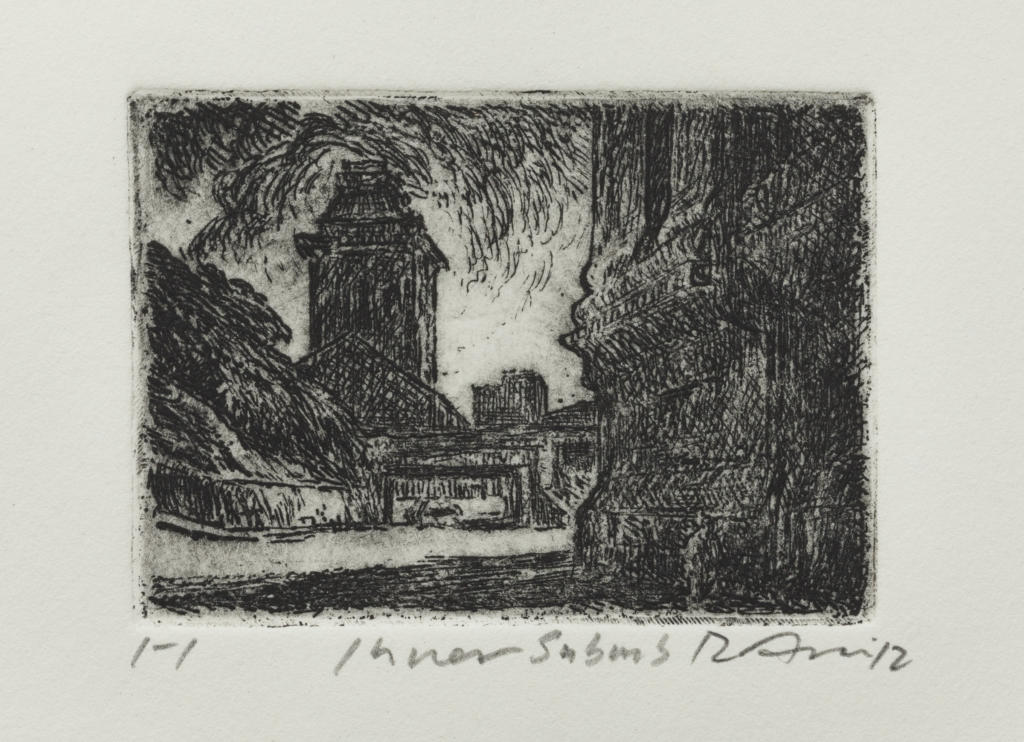
I. 1st state of 4
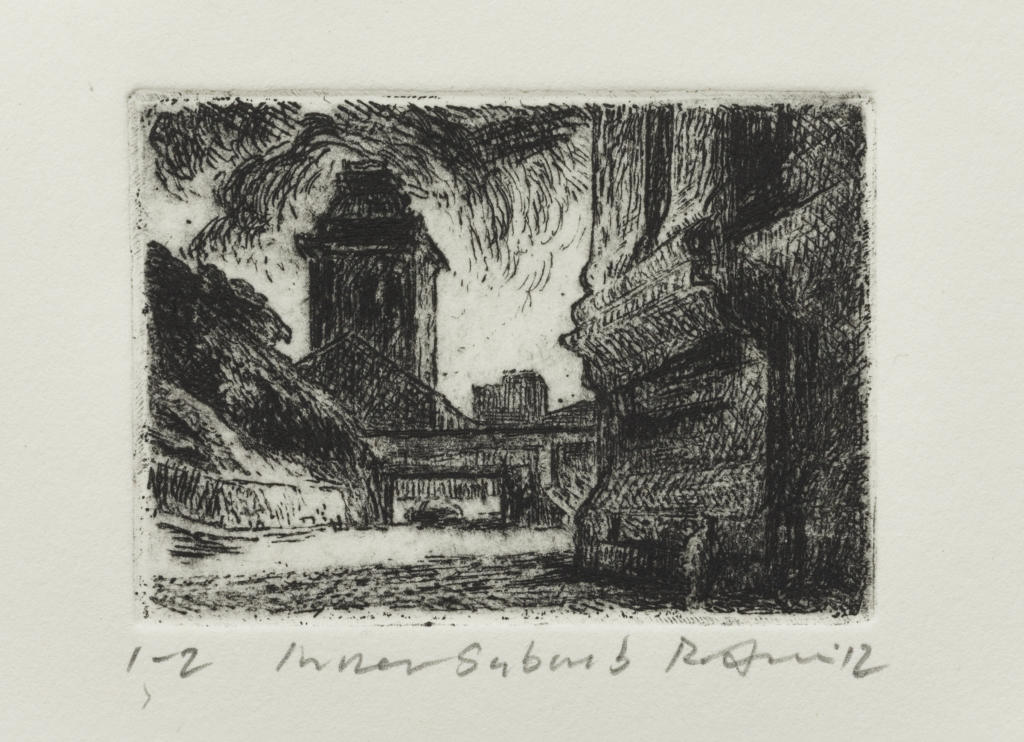
II.a. 2nd state of 4
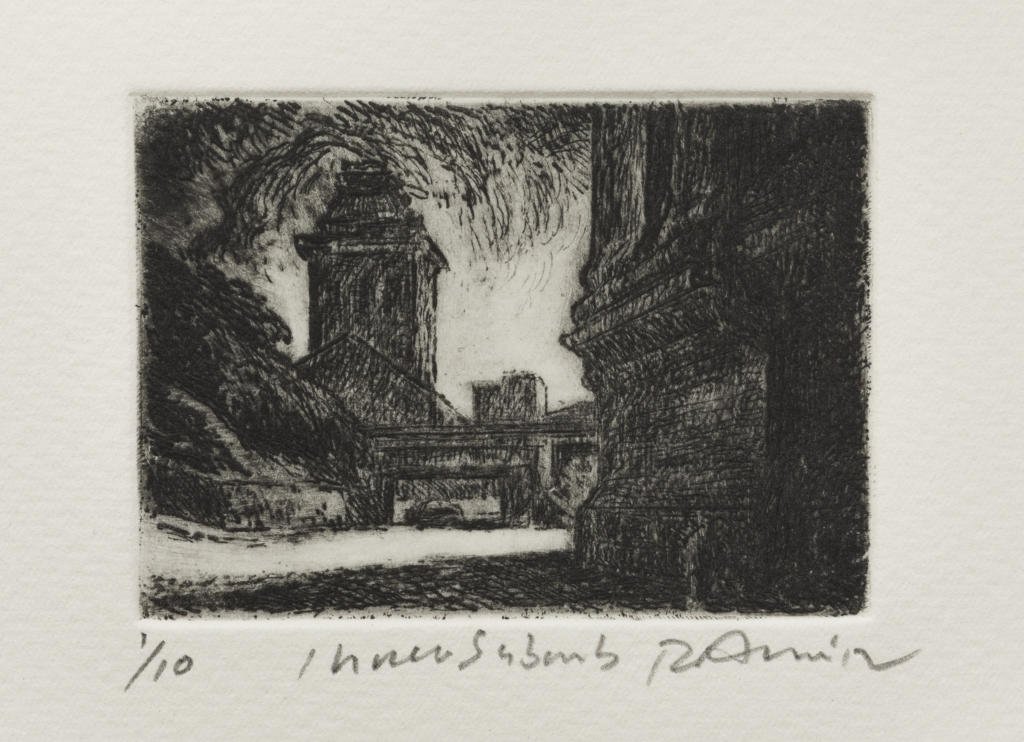
Edition impression, 2012 (Featured Image)

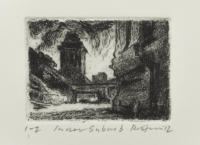

E.168 Inner suburb 2012
I. 1st state of 4
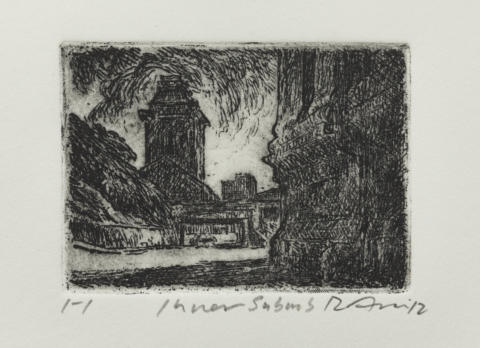
Etching. A composite street view in a nineteenth-century inner suburb of Melbourne. In the right foreground is the corner of an old building and in the left middle ground is a shrub-covered embankment, which supports a railway bridge beneath which is a car. Beyond is a nineteenth-century tower and, in the middle, a distant view towards a modern rectangular building. Billowing clouds in the upper sky encircle the tower.
Selectively wiped impression on cream wove Somerset paper, printed by Rick Amor in his Alphington studio. Inscribed in pencil, below the plate mark: lower left: ‘1-1’; lower centre: ‘Inner Suburb’; lower right: signed and dated ‘R Amor ’12’.
II.a. 2nd state of 4
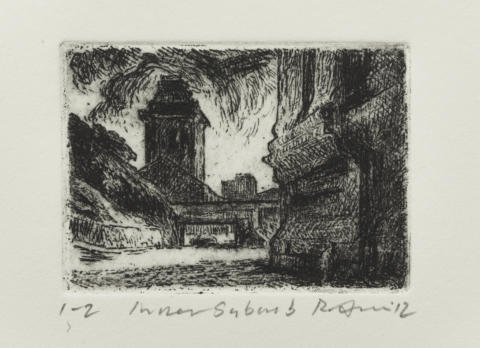
The addition of dark drypoint accents to many areas of the plate has introduced tonal modulation and enhanced the sense of volume and space. Deep shadows have been added to the building at right. The outlines of the bridge and car have been strengthened, as have the architectural details of the tower. Drypoint has been added to the raised bank at left, but the retaining wall has been burnished, as has the long shadow cast by the corner building. Several horizontal lines have been added to the road at the lower left, while the sky at the upper centre has also been darkened. There are two variant impressions of this state.
Edition impression, 2012 (Featured Image)
Drypoint has been added along the far right edge of the building at right.
Etching. A composite street view in a nineteenth-century inner suburb of Melbourne. In the right foreground is the corner of an old building and in the left middle ground is a shrub-covered embankment, which supports a railway bridge beneath which is a car. Beyond is a nineteenth-century tower and, in the middle, a distant view towards a modern rectangular building. Billowing clouds in the upper sky encircle the tower.
The addition of dark drypoint accents to many areas of the plate has introduced tonal modulation and enhanced the sense of volume and space. Deep shadows have been added to the building at right. The outlines of the bridge and car have been strengthened, as have the architectural details of the tower. Drypoint has been added to the raised bank at left, but the retaining wall has been burnished, as has the long shadow cast by the corner building. Several horizontal lines have been added to the road at the lower left, while the sky at the upper centre has also been darkened. There are two variant impressions of this state.
Drypoint has been added along the far right edge of the building at right.
- Catalogue Number
- E.168
- Title and Date
- Inner suburb 2012
- Description of Featured Image
- A composite street view of a nineteenth-century inner suburb of Melbourne. In the right foreground is the corner of an old building, and in the left middle ground is a shrub-covered embankment that supports the left side of a railway bridge; there is a car beneath the bridge. Further in the distance is a nineteenth-century tower and, in the middle, a distant view of a modern rectangular building. Billowing clouds in the upper sky encircle the tower.
- Where Made
- Alphington, Melbourne
- Medium Category and Technique
- Intaglio Print: Etching, drypoint and burnishing on copper
- Support
- Wove paper. Identified papers: Cream Somerset paper; white Hahnemühle paper.
- Dimensions
-
Image size: 52 x 72 mm
Matrix size: 52 x 72 mm - Artist’s Record Number
- RAE.205
- Printer(s) and Workshop(s)
- All state impressions printed by Rick Amor in his Alphington studio. Edition printed by Rosalind Atkins at Kate Herd’s studio, Alphington.
- Summary Edition Information
- Four states. Edition of ten numbered impressions, 2012.
- Exhibitions
- Art Gallery of South Australia 2016–17: Art Gallery of South Australia, Adelaide, Rick Amor: Contemporary Romantic, 2 December 2016 – 30 April 2017 [no catalogue].
- Literature
- For an illustration of the painting Inner suburb, 2013, see Philip Bacon Galleries, Rick Amor (exh. cat.), Philip Bacon Galleries, Brisbane, 2014, p. 19, cat. no. 12.
- Collections
- State Library of Victoria, Melbourne: five state impressions, numbered 1-1 through 1-4, 2-4; ed. 2/10.
- Art Gallery of South Australia, Adelaide: AP (promised gift).
- Comment
This is a composite view of various streets and buildings in Melbourne’s inner suburbs and includes the mansard tower located near the corner of Wellington and Langridge Streets, Collingwood. The print was made after an oil of the same title, painted in February 2007; both works are oriented in the same direction and E.168 is very close to the painting in its distribution of light and dark areas, especially in the sky with its wheeling clouds around the tower. The development of the image through its four states addressed this matter of tonal equivalence, as did the wiping of the plate.
The etching resulted from a provocation issued by the writer and publisher Lou Klepac, who challenged Amor to make a miniature etching of a streetscape.
A variant of the subject of this print appeared in a painting from 2013, also titled Inner suburb, which was exhibited in 2014 at Philip Bacon Galleries, Brisbane (Philip Bacon Galleries 2014).
- Keywords
- Cityscapes & streetscapes, Collingwood (Melbourne), Lou Klepac, Streetscape
- URL
- https://catalogue.rickamor.com.au/works/intaglio/inner-suburb-2/
Record last updated 17/02/2021